

Weekly writing about the art market and the convergence of art and technology. By day, I’m a partner at the Robert Fontaine Gallery and a data science consultant. By night, I write Artxiom, ideas at the intersection of art, technology, and finance.
If you haven’t subscribed, join today by subscribing here:
Exceptional Works: Cy Twombly
"My line is childlike but not childish. It is very difficult to fake... to get that quality you need to project yourself into the child's line. It has to be felt".
- Cy Twombly
Cy Twombly
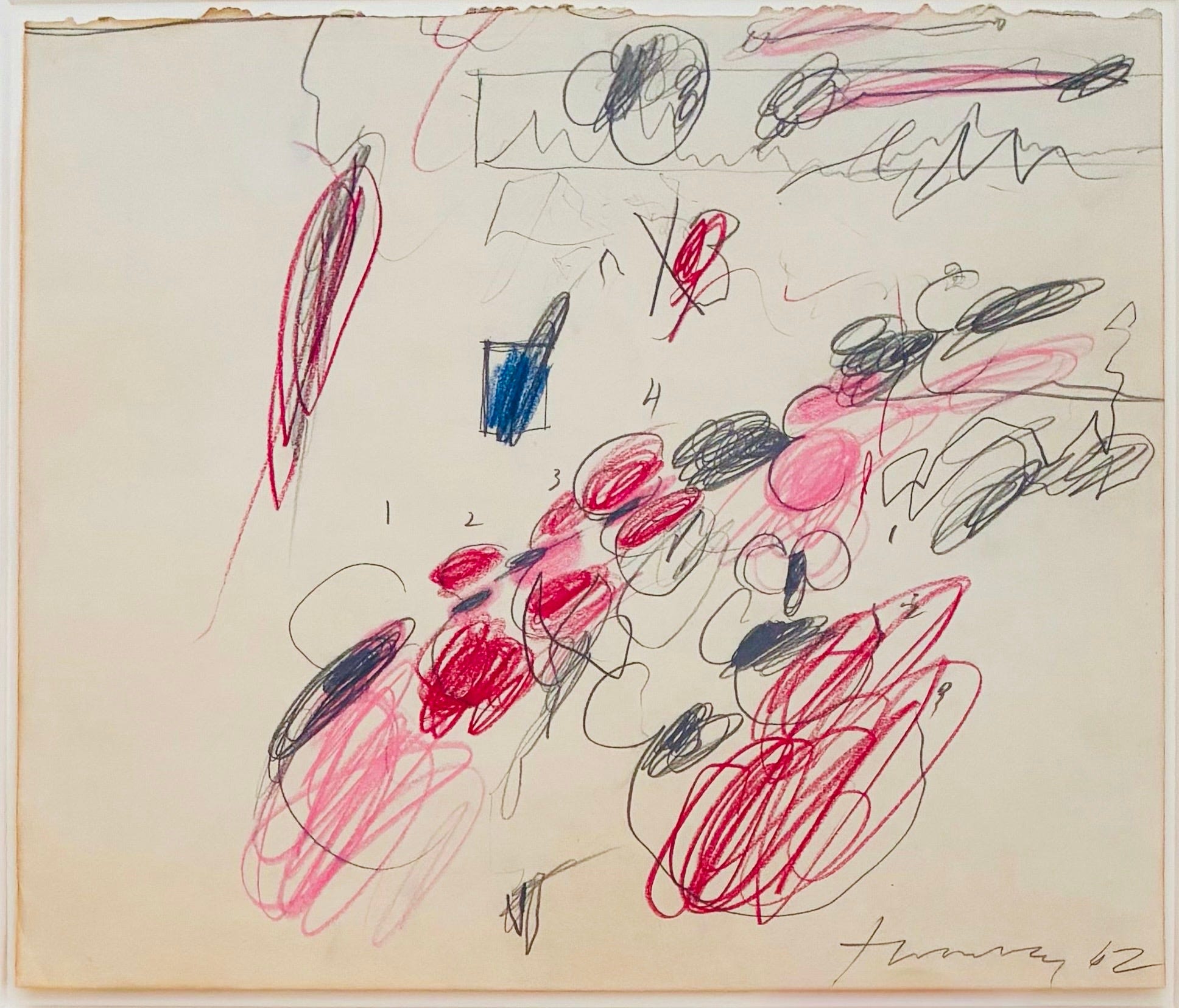
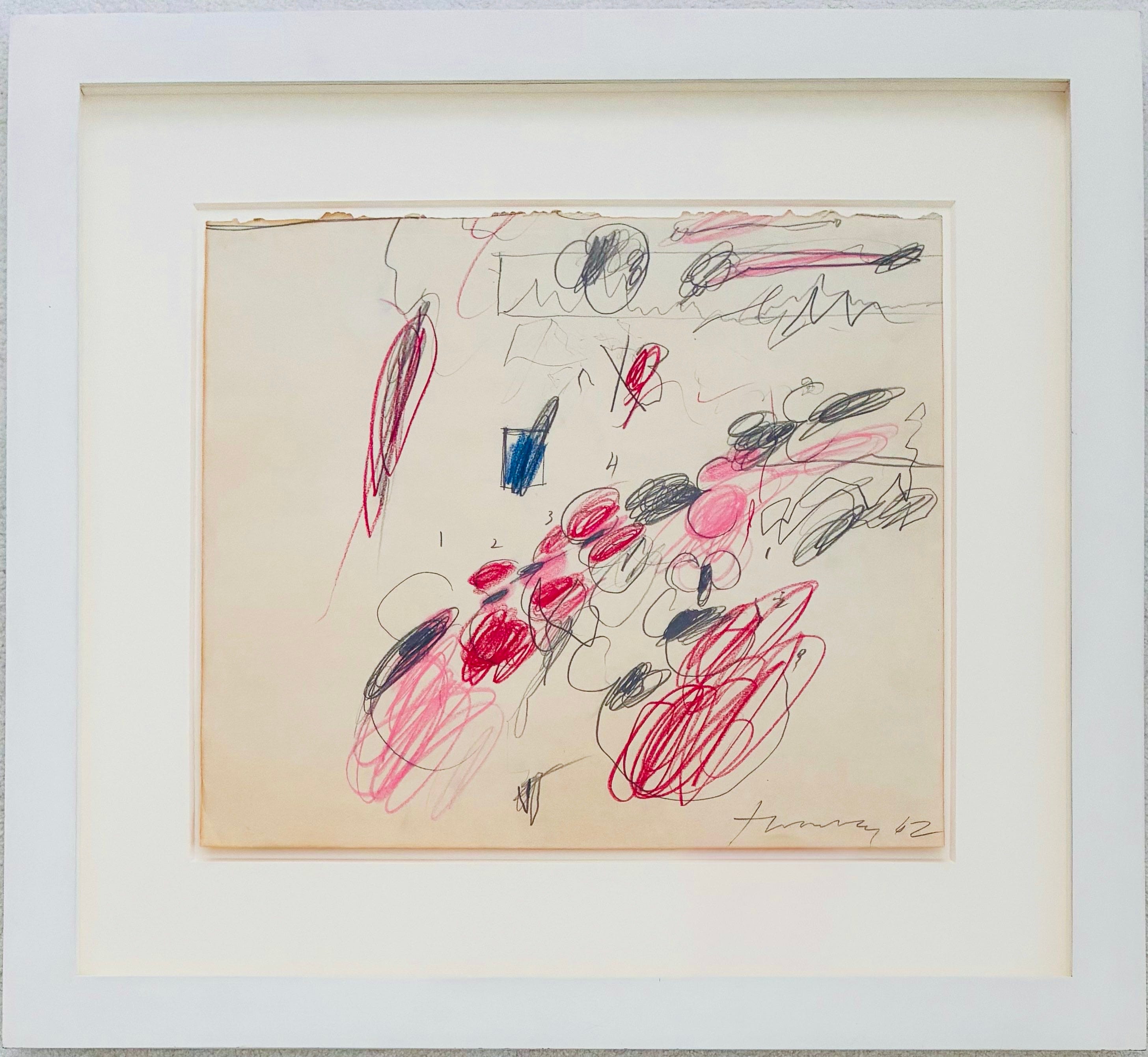
Untitled, 1962
Pencil, wax crayon
Signed and dated bottom right on recto in pencil: Twombly 62
Cat. No. 199
15 1/4 x 17 3/4 inches
Provenance
- Private Collection
- Galerie Di Meo, Paris
- Cheim & Read, New York
- Kagan Martos Gallery, New York
Exhibitions
- Galerie Xavier Hufkens, Cy Twombly 2000
- New York, Kagan Martos Gallery, Painting Generation 1920-2000
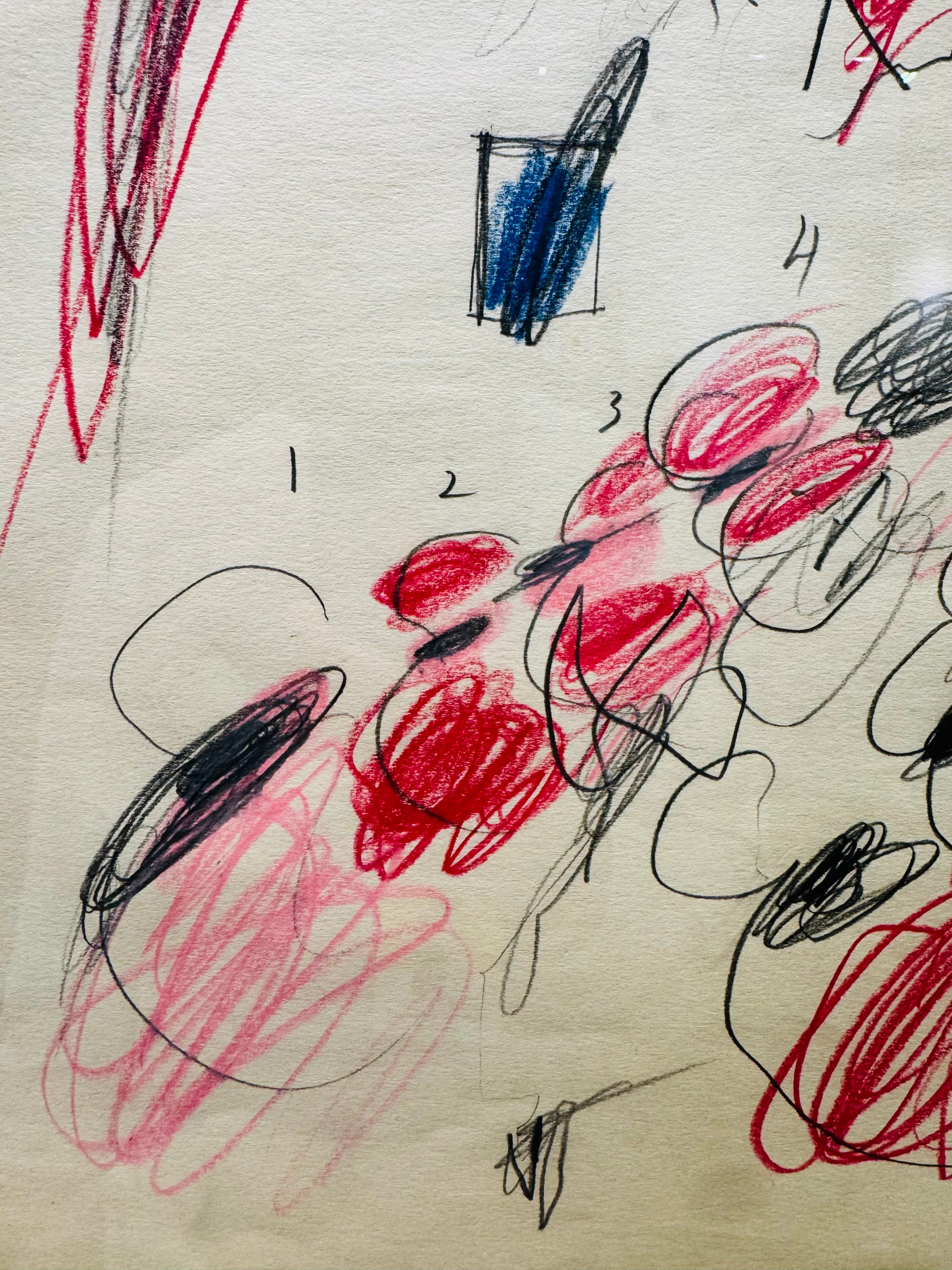
Untitled (1962) is an intricate and expressive work by American artist, Cy Twombly (1928–2011). Composed of looping red and pink forms, restless graphite lines, and scattered numerical markings, the drawing unfolds across the paper with lyrical intensity. In a dreamlike field of gesture where writing and drawing merge, the work reflects not only on his spontaneous mark-making, but also on his deep engagement with memory, language, and the poetic possibilities of abstraction.
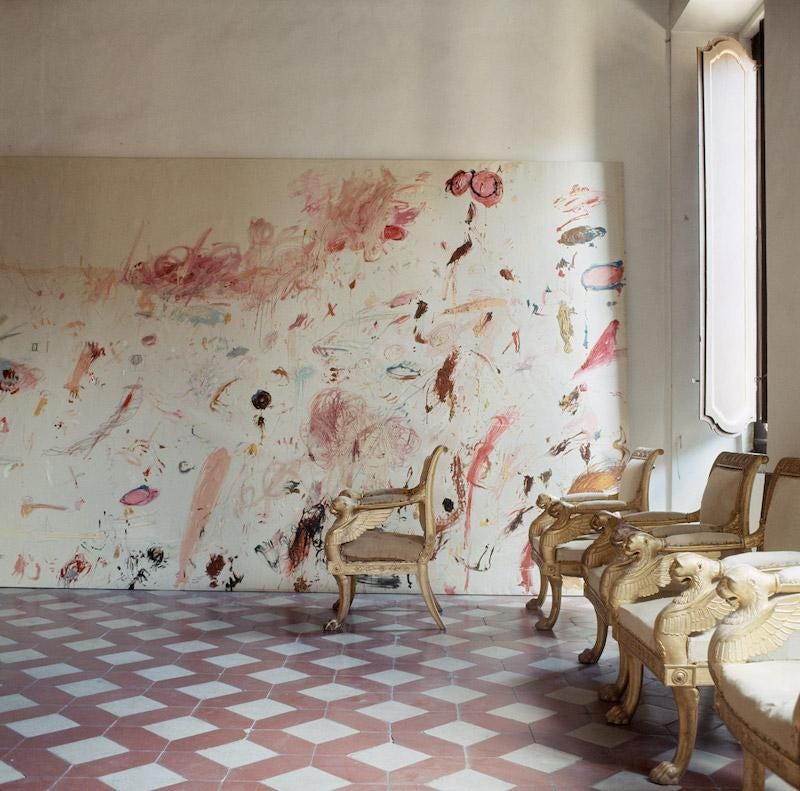
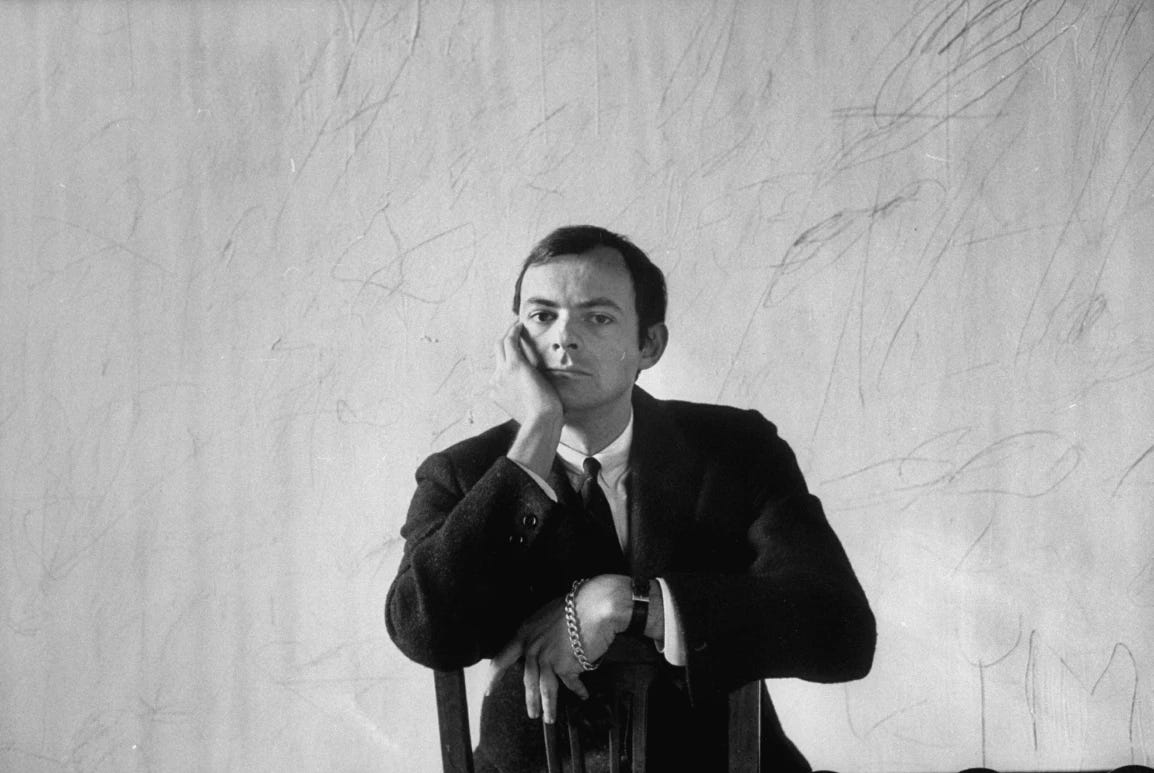
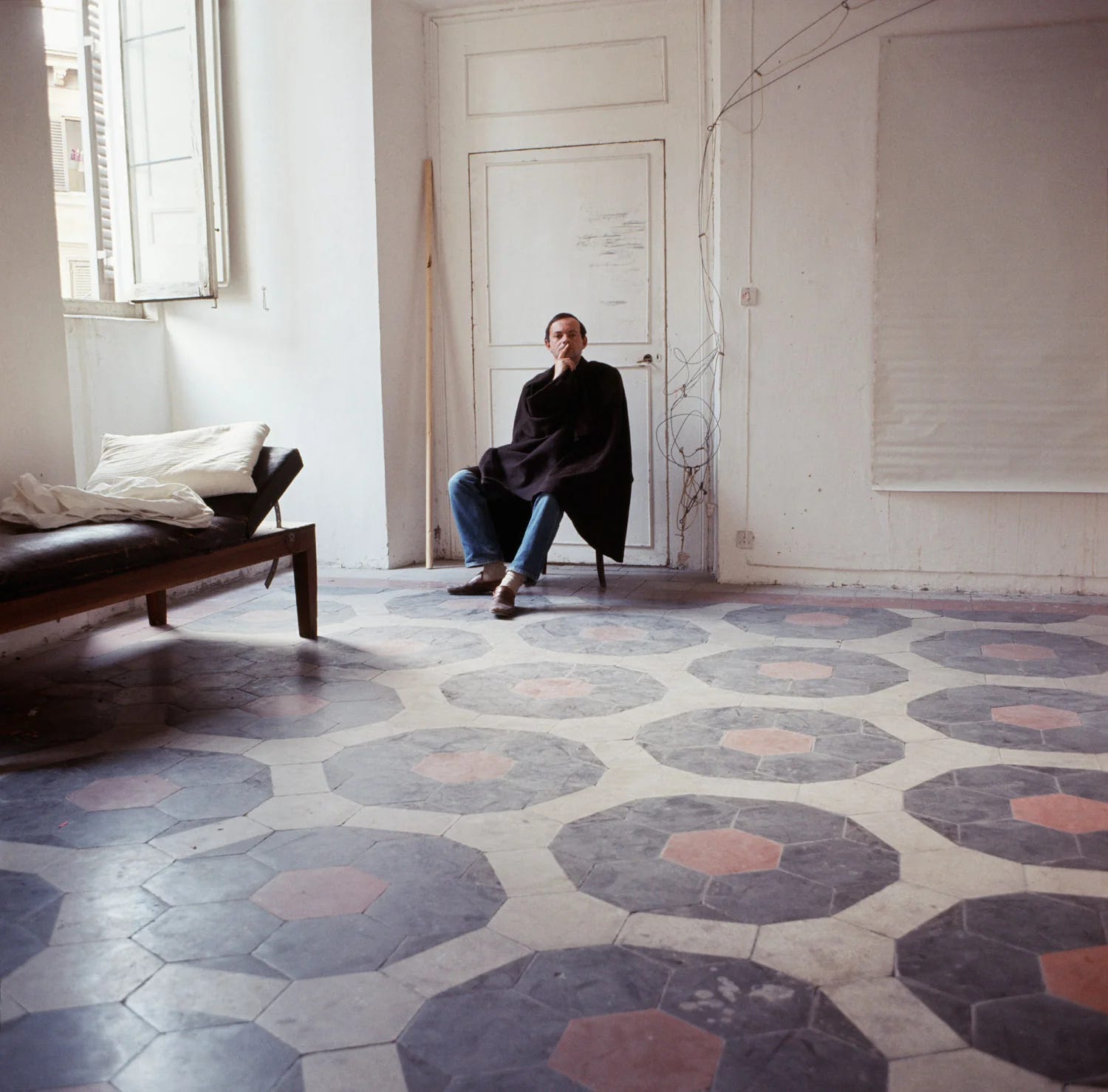
Cy Twombly is widely regarded as one of the most influential artists of the postwar period, known for redefining drawing and painting as acts of memory, gesture, and poetic inscription. Emerging in the 1950s alongside Abstract Expressionism, Twombly rejected the movement’s emphasis on heroic scale and painterly virtuosity in favor of a more intimate, fragile, and psychologically charged visual language. His work is characterized by looping lines, erasures, scrawled marks, and fragments of text that evoke writing without narrative, positioning the act of drawing as a form of thought rather than representation. (Fig. 4)
Executed in 1962, Untitled dates from a decisive and highly sought-after period in Twombly’s career, when his radical approach to painting had fully materialized. By this time, Twombly had established a transatlantic presence, dividing his life between Italy and the United States. His immersion in European art history, classical mythology, and poetry, particularly the themes of eros, tragedy, and time, deeply informed his practice, distinguishing it from that of his American contemporaries.
The present work exemplifies Twombly’s mature early-1960s drawing language. Looping graphite lines, crossing-outs, and schematic notations create a surface that feels spontaneous and deliberate, as if recording the residue of repeated gestures over time. The red crayon passages introduce a visceral, bodily intensity often associated with Twombly’s exploration of desire and violence almost suggesting heat and flesh, while darker marks punctuate the composition like moments of interruption or emphasis. Rather than seeking resolution, the drawing embraces instability, allowing meaning to emerge through accumulation, erasure, and failure. The marks are not merely illustrative. Rather, they register sensation. The viewer does not read the image so much as feel it. (Fig. 5)
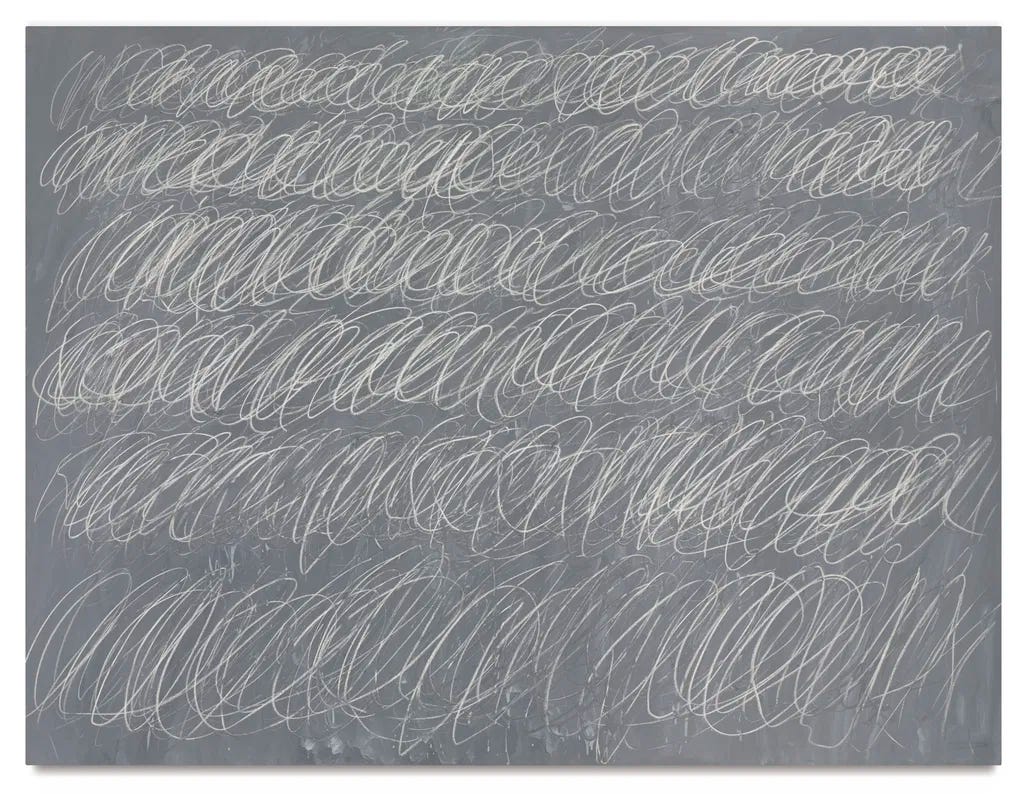
Historically, this period marks Twombly’s shift from marginal reception to critical recognition, particularly in Europe, where his work was championed by leading curators and intellectuals. His drawings and paintings from the early 1960s are now recognized as foundational to his oeuvre, laying the groundwork for later monumental series and the “blackboard” paintings such as Untitled (New York City), 1968 (Fig. 6) sold at Sotheby’s November 11, 2015 for $70.5 million. Major examples from this early period are held in institutional collections such as the Museum of Modern Art, New York; Tate Modern, London; and the Centre Pompidou, Paris.
From a market perspective, works on paper from 1960–1963 are among the most actively collected and tightly held segments of Twombly’s practice. Their relative rarity, combined with their historical importance and immediacy, has led to sustained demand among international collectors. Since the early 2000s, Twombly’s market has experienced an extraordinary explosion transforming him into one of the most expensive and sought-after contemporary artists, reinforced by major retrospectives and scholarly reassessments. Drawings from this period are especially valued for their directness, offering an intimate encounter with the artist’s hand and thought process.
Untitled, 1962 stands as a compelling introduction to Twombly’s practice and a powerful example of his ability to transform elemental gestures into a poetic, historically resonant visual language, one that introduced lyricism, erudition, and vulnerability into abstraction for the first time.
Ultimately, the drawing embodies Twombly’s central achievement, which is to transform scribble into a form of fine poetic expression. In 1962, he was not merely making marks; he was inventing a visual language capable of carrying history, mythology, and personal emotion without ever settling into fixed narrative. The work stands as a testament to his belief that abstraction could be as literary, sensual, and human as any figurative art.
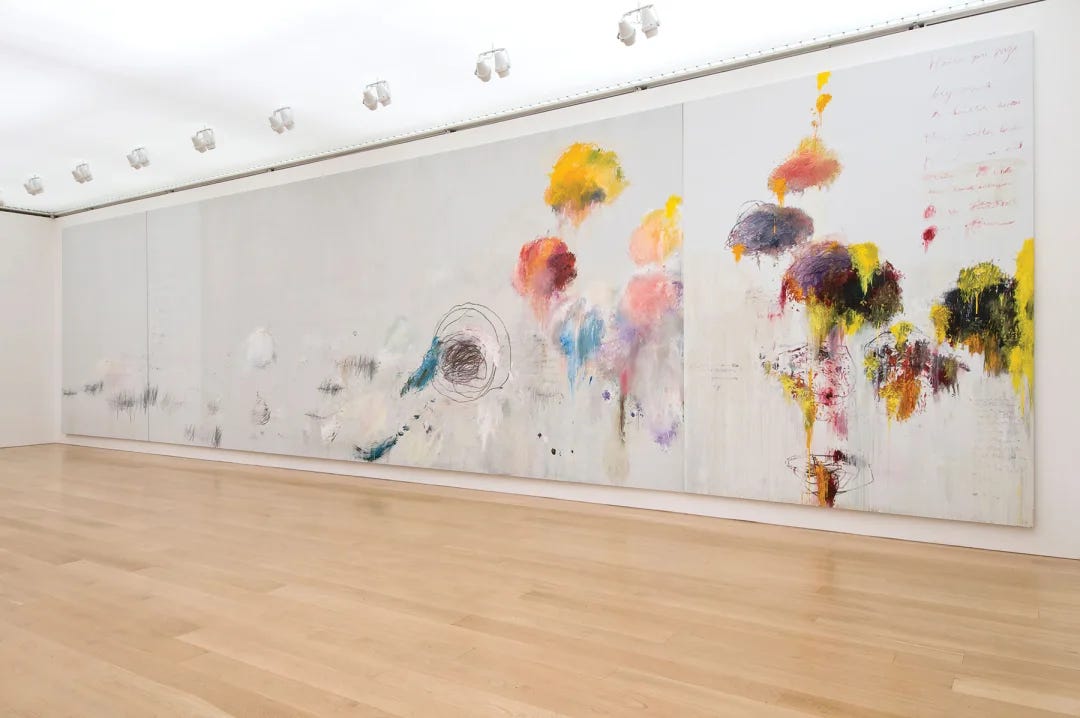
Cy Twombly has been the subject of numerous solo exhibitions and presentations. He was invited to exhibit his work at the 1964 Venice Biennale. In 1968, the Milwaukee Art Center mounted his first retrospective. The artist was honored with numerous other shows, including major retrospectives organized by Kunsthaus Zürich, Zurich (1987); Musée national d’art moderne, Centre Pompidou, Paris (1988); Museum of Modern Art, New York (1994); Pinakothek der Moderne, Munich (2006); Tate Modern, London (2008); and Art Institute of Chicago (2009). In 1995, the Cy Twombly Gallery, exhibiting works made by the artist after 1954, opened in Houston at the Menil Collection. Twombly died on July 5, 2011, in Rome.
For more information inquire below:
Thanks for reading! Subscribe here to receive Artxiom in your inbox each week: