

Weekly writing about the art market and the convergence of art and technology. By day, I’m a partner at the Robert Fontaine Gallery and a data science consultant. By night, I write Artxiom, ideas at the intersection of art, technology, and finance.
If you haven’t subscribed, join today by subscribing here:
Exceptional Works: Joseph Cornell
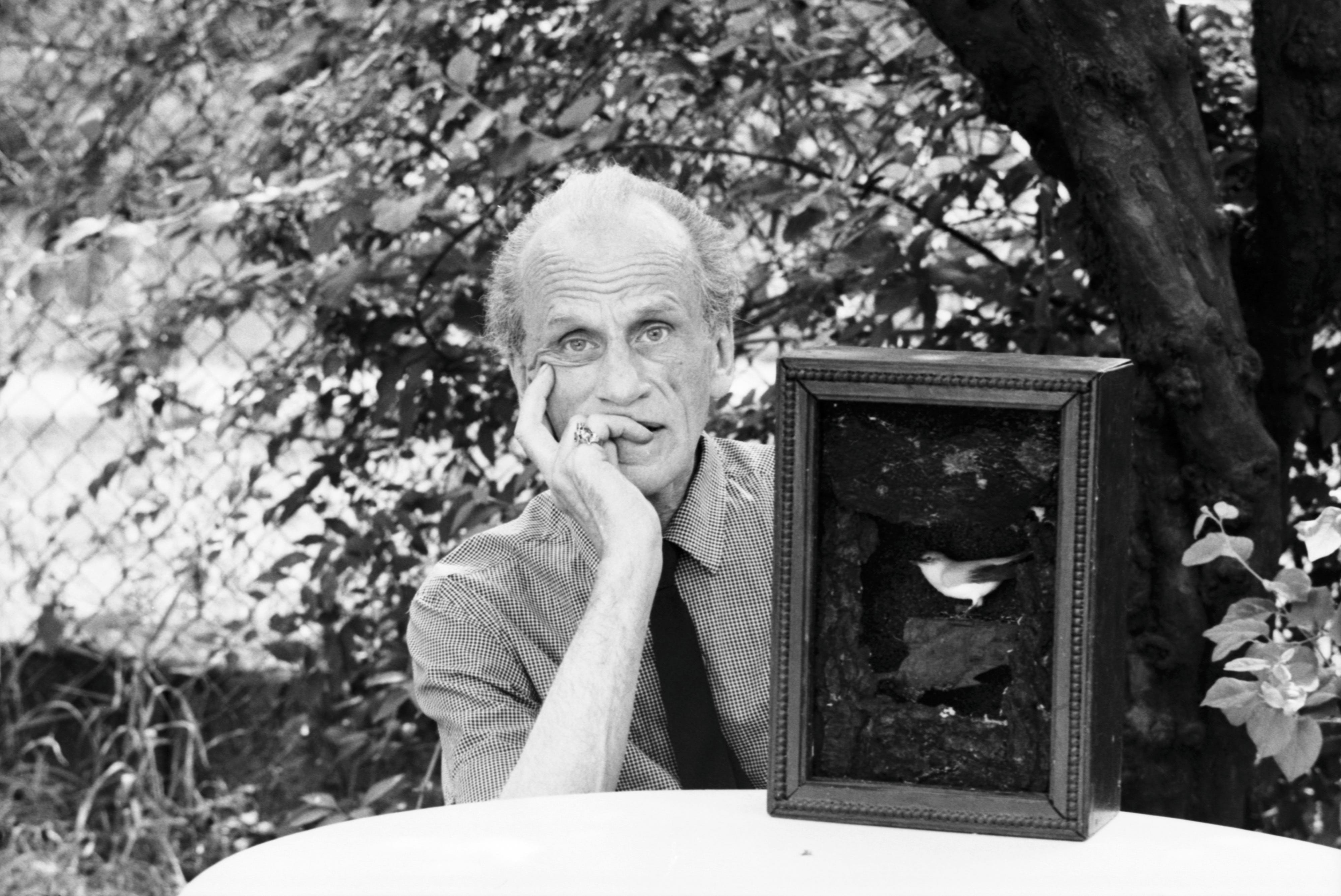
"Look at everything as though you are seeing it for the first time, with eyes of a child, fresh with wonder."
- Joseph Cornell
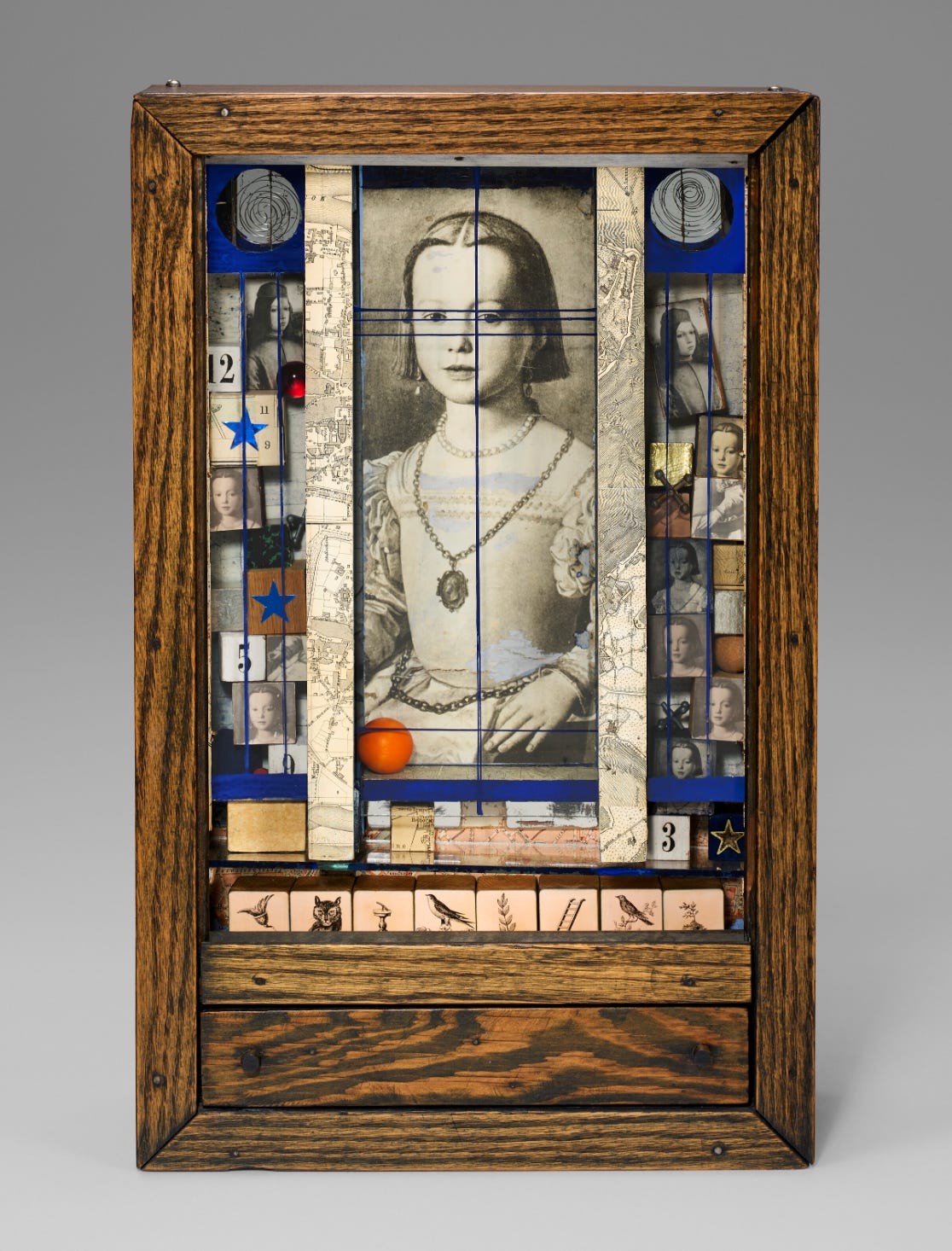
Among the most singular artistic voices of the twentieth century emerged Joseph Cornell, whose deeply poetic assemblages transformed everyday fragments into spaces of reverie, memory, and wonder. Best known for his iconic shadow boxes (Fig.2), Cornell developed a highly personal visual language rooted in collecting, juxtaposition, and association. Untitled (Medici Princess), a brilliant example of his shadow boxes, recently sold at Christie’s for $ 6.9 million. Drawing upon found photographs, books, maps, astronomical diagrams, theater ephemera, natural history imagery, and fragments of European culture, Cornell assembled worlds suspended between dream and observation.
Although frequently associated with Surrealism, Cornell remained distinct from the movement’s more psychological or disruptive impulses. Self-taught and working largely in isolation from his home in Queens, New York, he cultivated a quieter sensibility, informed by nostalgia, cinema, ballet, astronomy, romantic longing, and an enduring fascination with travel, much of it imagined rather than experienced. His art possesses an unmistakable lyricism, intimate yet expansive, fragile yet cosmological.
By the 1960s, Cornell’s works on paper had evolved toward an increasingly restrained and atmospheric form. While his earlier constructions often contained dense accumulations of found objects and imagery, the later collages frequently became more meditative, pared down, and spatially open. Rather than assembling many fragments, Cornell often allowed a single image, gesture, or poetic association to resonate quietly within a larger field.
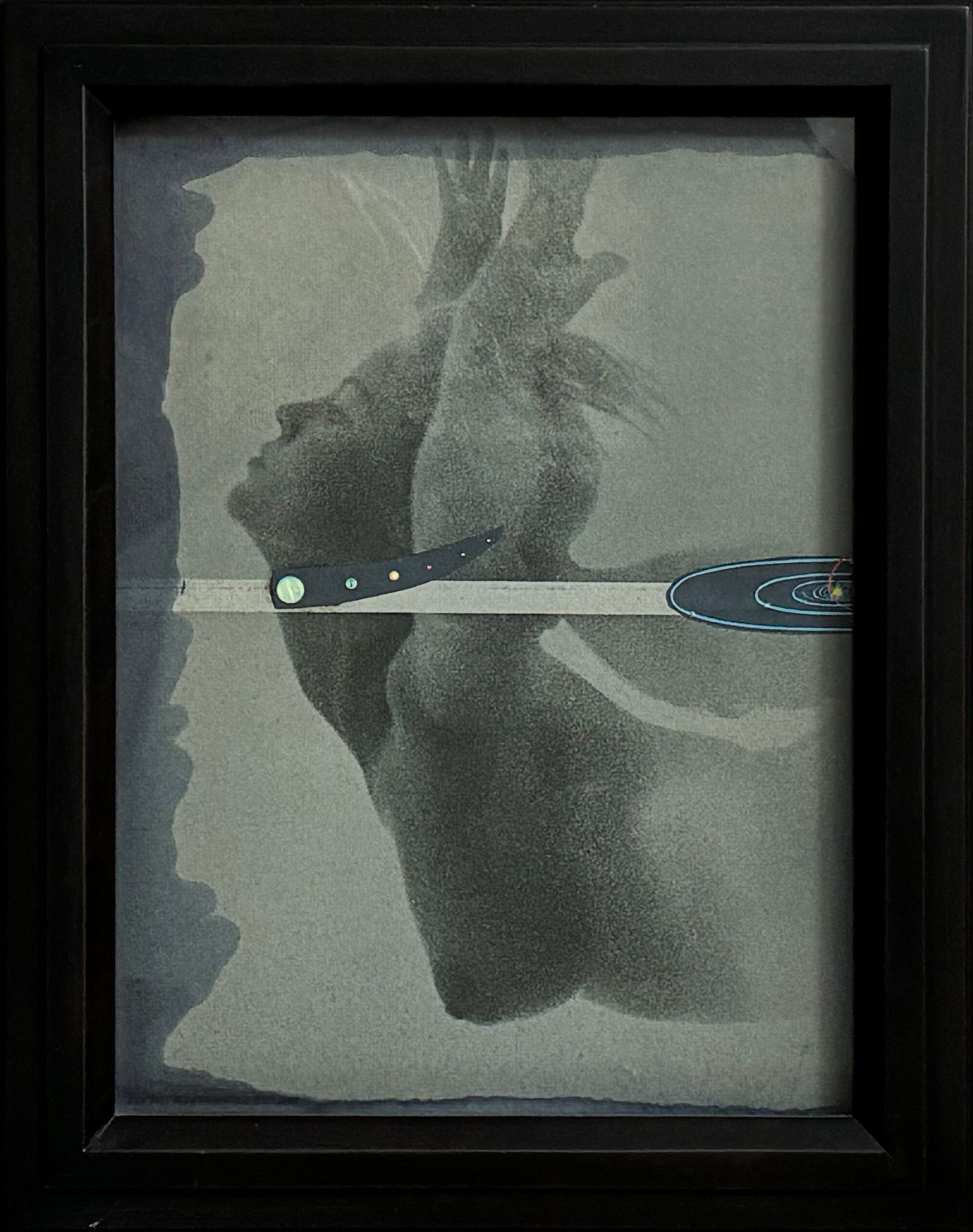
These late works reveal Cornell’s mature preoccupations in distilled form: celestial diagrams, geometric structures, idealized feminine figures, birds, fragments of historical portraiture, travel references, and traces of scientific observation (Fig. 3). Delicate marks, grids, circular forms, and faded surfaces lend many works an air of suspension, as though the images exist in a state between memory and disappearance. Time in Cornell’s world is rarely linear; instead, it folds together eras, emotions, and associations into intimate constellations.
The present group of six works on paper in this article exemplifies this late sensibility with exceptional coherence. Though varied in imagery, they are united by a subtle emotional atmosphere and recurring symbolic vocabulary.
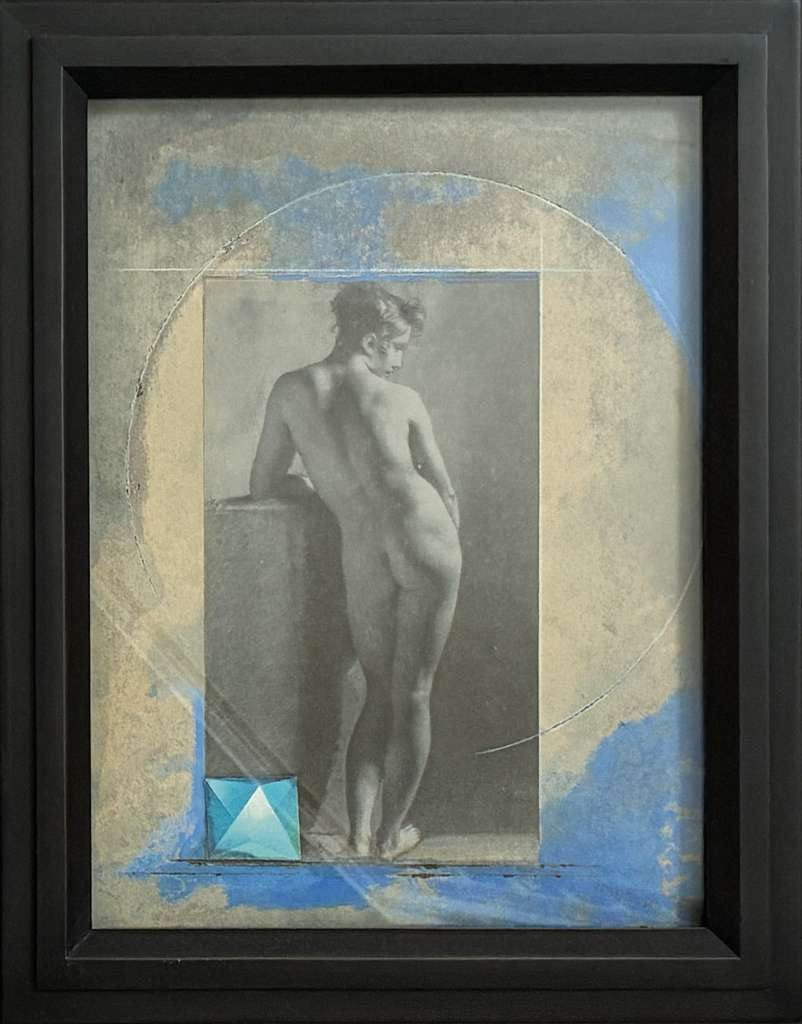
A recurring motif throughout the group is Cornell’s enduring fascination with the feminine image. Ethereal female forms appear suspended in dreamlike space, removed from ordinary narrative and transformed into vessels of contemplation, for example, The Cloud, les vents generaox, 1966-70 (Fig.4) In another work, Untitled, circa 1960s (Fig.3), a spectral female body merges with planetary references and orbital imagery, creating a striking juxtaposition between intimacy and cosmology. The female figure becomes celestial, simultaneously grounded and immeasurable.
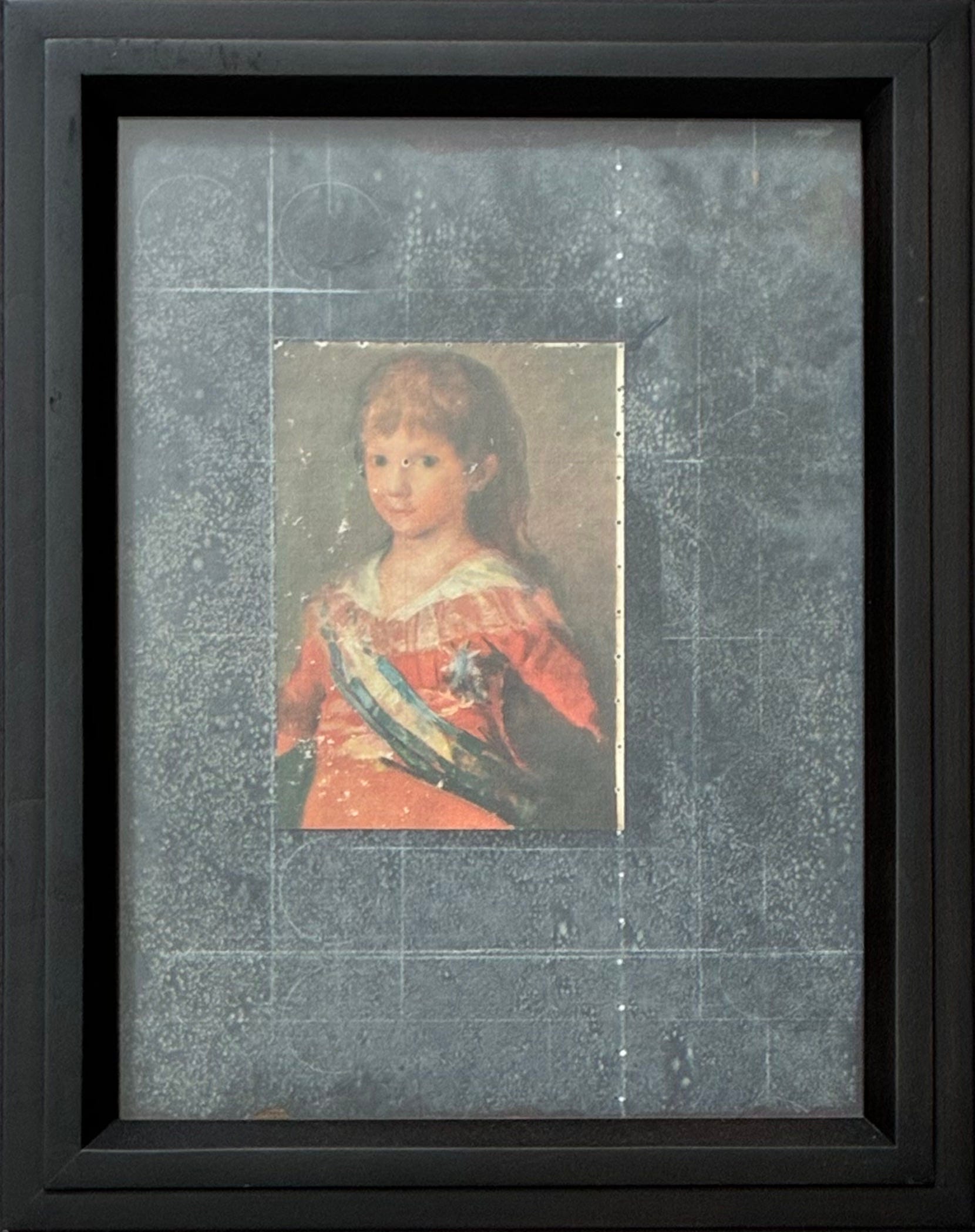
Elsewhere, historical portraiture emerges as a meditation on memory and temporal displacement. The image of a young girl, Untitled, circa 1960s (Fig. 5), isolated within a misted geometric field, evokes Cornell’s lifelong attraction to found portraits and anonymous stories. Detached from their original context, such figures become strangely timeless, hovering between remembrance and invention.
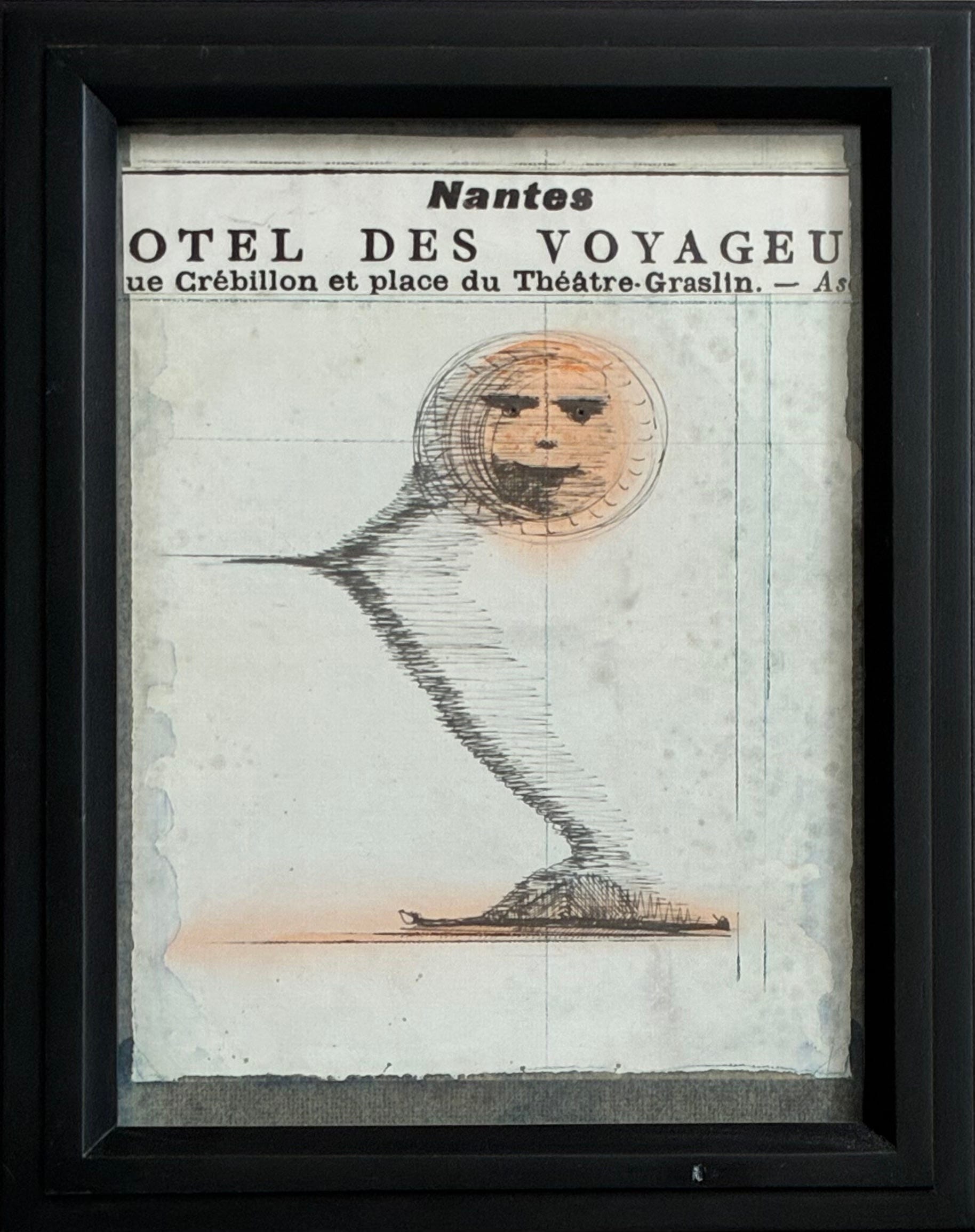
Travel and imagined geography also surface as persistent themes. The work incorporating French printed ephemera referencing Nantes and Hotel des Voyageurs, The Smile in the Gift Shop, circa 1960s (Fig. 6), suggests movement, longing, and the romance of somewhere. Cornell, who often experienced distant places through books, postcards, cinema, and collected material, transformed fragments of geography into emotional landscapes.
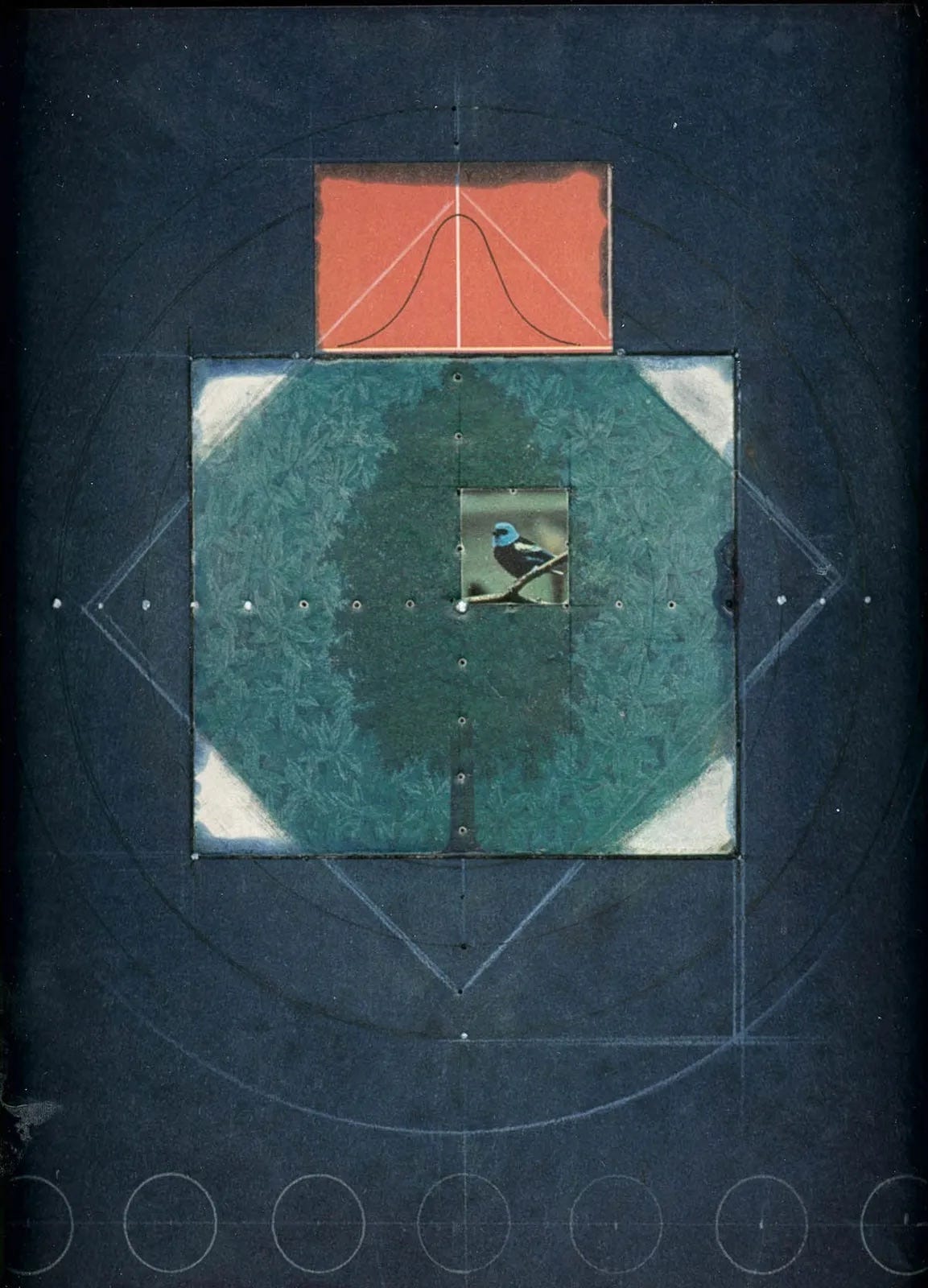
Astronomy and systems of order quietly organize the group. Circular forms, measured lines, grids, geometric structures, and cosmic references appear repeatedly, reflecting Cornell’s lifelong fascination with celestial observation. Yet, these scientific motifs are never clinical; instead, they function poetically, balancing rational structure against mystery and emotion. Particularly striking is the geometric composition incorporating a small bird image, Untitled (2C-38E), 1969 (Fig. 7), an exquisite synthesis of precision and reverie, where symbolic order gives way to fragile life.
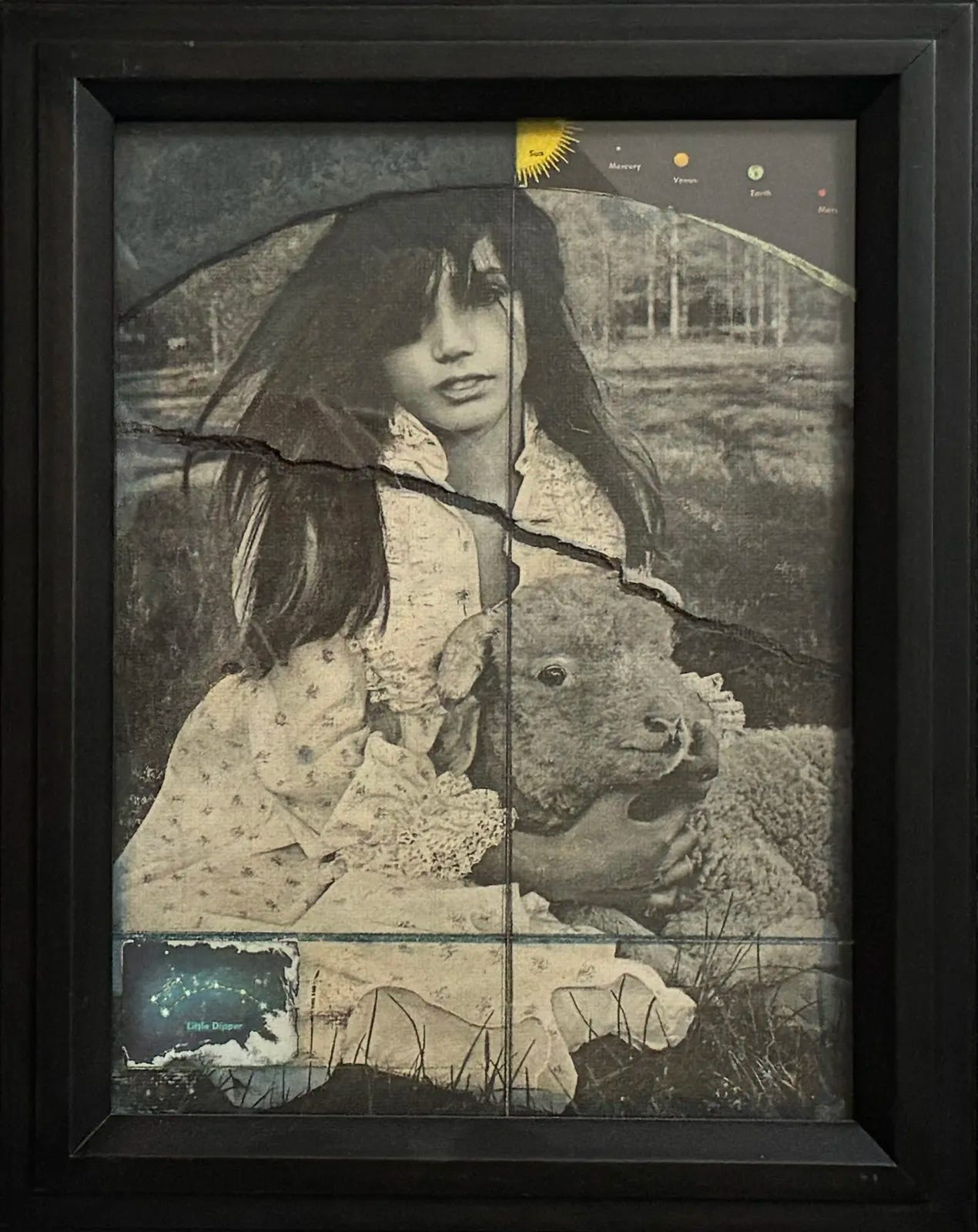
Equally important within this group is Cornell's sustained engagement with childhood and the natural world. In Untitled, 1965 (Fig. 8), a young woman embraces a lamb beneath celestial diagrams and references to the Little Dipper, creating an image that is at once pastoral and cosmic. The work exemplifies Cornell's ability to dissolve conventional boundaries between the earthly and the celestial, linking innocence, nature, and wonder within a single poetic field. Such juxtapositions reveal a central aspect of Cornell's mature vision, the belief that the smallest and most intimate experiences could serve as gateways to larger mysteries of time, memory, and the universe itself.
Seen together, these six works reveal Cornell at his most distilled and lyrical. Their restraint is deceptive; within sparse compositions and softened surfaces exists an expansive emotional universe, a Cornellian world, shaped by childhood, memory, nature, femininity, and the cosmos. These aspects exemplify the singular ability of Cornell’s late works on paper to transform fragments of the world into intimate cosmologies, spaces where science meets poetry, history dissolves into dream, and the ordinary becomes quietly miraculous.
Joseph Cornell has been the subject of numerous important museum exhibitions and retrospectives. During his lifetime, his work was presented at institutions including the Solomon R. Guggenheim Museum, where a major retrospective was organized in 1967. Subsequent exhibitions have been held at the Museum of Modern Art, Smithsonian American Art Museum, Peabody Essex Museum, and Royal Academy of Arts, among others. A landmark retrospective, Joseph Cornell: Navigating the Imagination, traveled between the Peabody Essex Museum and the Smithsonian American Art Museum in 2007–08, reaffirming Cornell's position as one of the most original figures in modern art. Today, his work is held in the permanent collections of virtually every major museum of modern and contemporary art, including the Museum of Modern Art, Metropolitan Museum of Art, Whitney Museum of American Art, Art Institute of Chicago, National Gallery of Art, and Tate, underscoring his enduring influence on generations of artists working across collage, assemblage, installation, and conceptual art.
For more information about these works, inquire below:
Thanks for reading! Subscribe here to receive Artxiom in your inbox each week: