

Weekly writing about the art market and the convergence of art and technology. By day, I’m a partner at the Robert Fontaine Gallery and a data science consultant. By night, I write Artxiom, ideas at the intersection of art, technology, and finance.
If you haven’t subscribed, join today by subscribing here:
Exceptional Works: Wolf Kahn
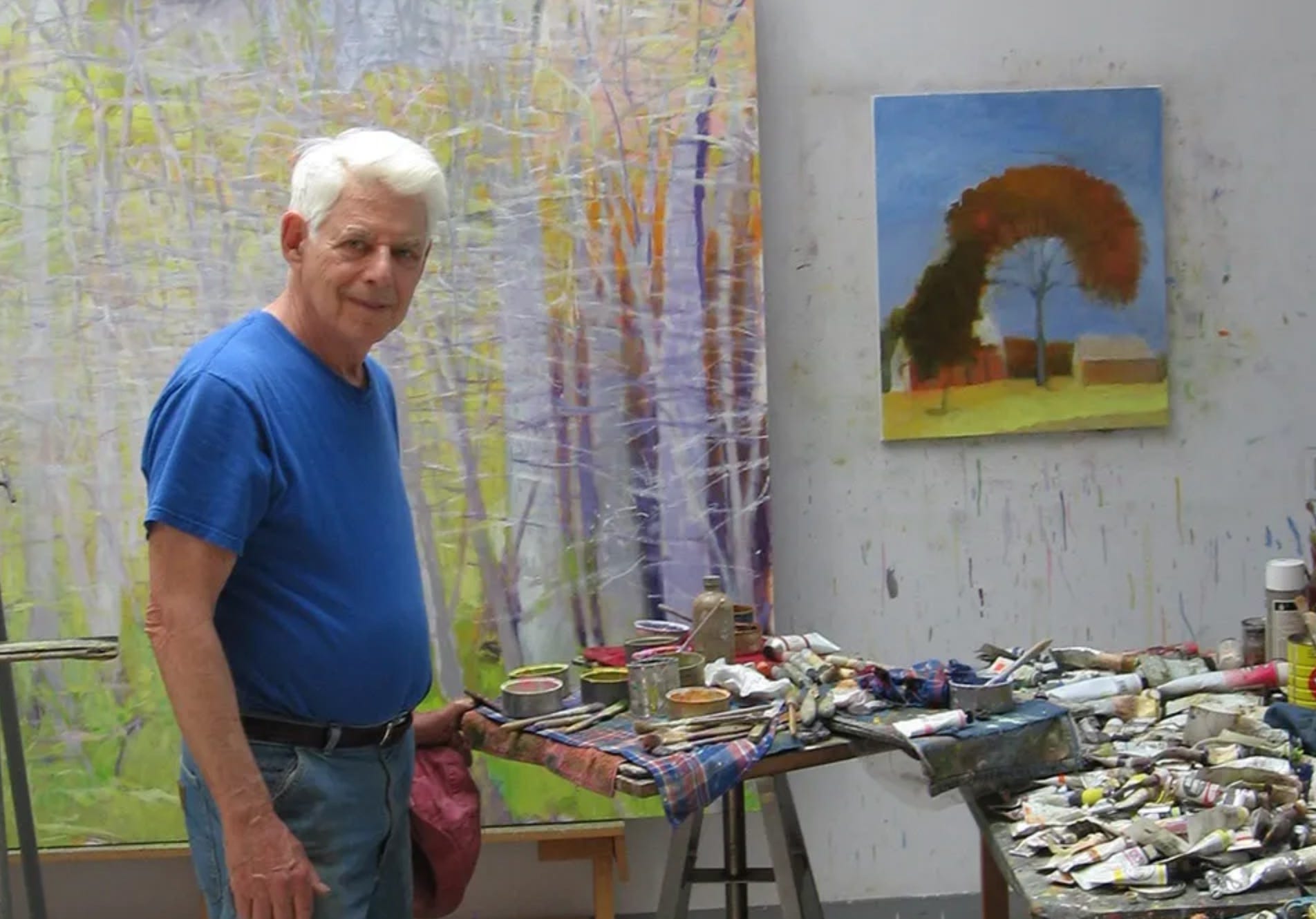
Few subjects appear as persistently in the work of Wolf Kahn (1927-2020) as the American barn. Yet, to call Wolf Kahn’s barns simply “landscape paintings” is to miss what makes them so compelling. For Kahn, the barn was never merely an emblem of rural America. It became a remarkably flexible structure through which he could explore color, form, and the boundary between representation and abstraction.
A second-generation New York School artist and a student and apprentice of Hans Hofmann, Kahn developed a distinctive language that brought together the expressive energy of Abstract Expressionism with the visual traditions of American landscape painting. He was also deeply influenced by artists such as Milton Avery, Henri Matisse, and Mark Rothko, particularly in their use of color as an independent expressive force. This is why Kahn can sometimes be understood as working in a Rothko-esque vein, taking the experience of the natural world and translating it into expansive fields of color.
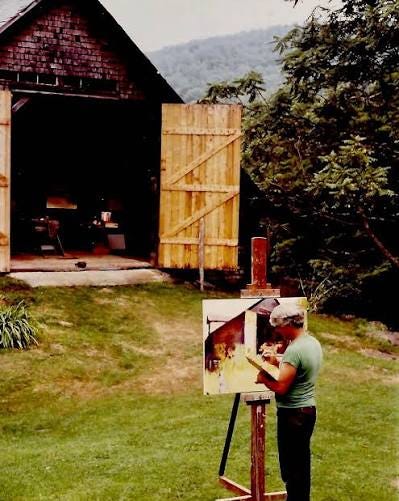
The American barn (Fig. 2) offered Kahn an ideal subject because of its simplicity. Architecturally, it is a collection of geometric planes; placed within a landscape, that structure creates an immediate dialogue between the man-made and the natural. Kahn could push the barn almost toward abstraction while still giving the viewer something recognizable to hold onto. Essentially, he was not interested in painting a barn as an illustration of a barn. He was asking what happens when a very simple geometric structure is placed against nature. This tension between recognition and abstraction is central to Kahn’s art. The barn is unmistakably a barn, but its purple walls, orange surfaces, brilliant yellow fields, or unexpectedly blue surroundings, for instance, may have little to do with literal perceived colors. Instead, color becomes a means of conveying sensation.
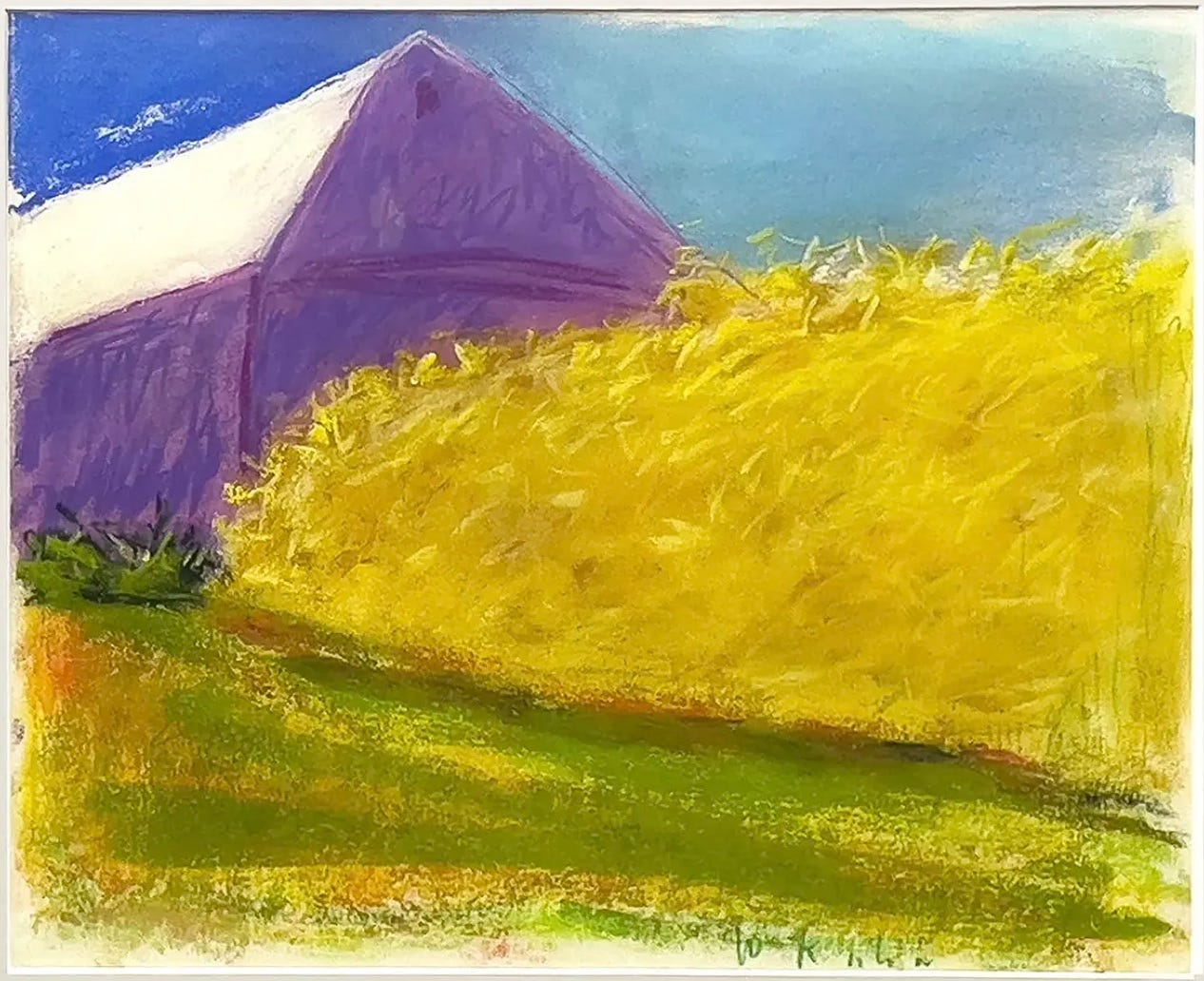
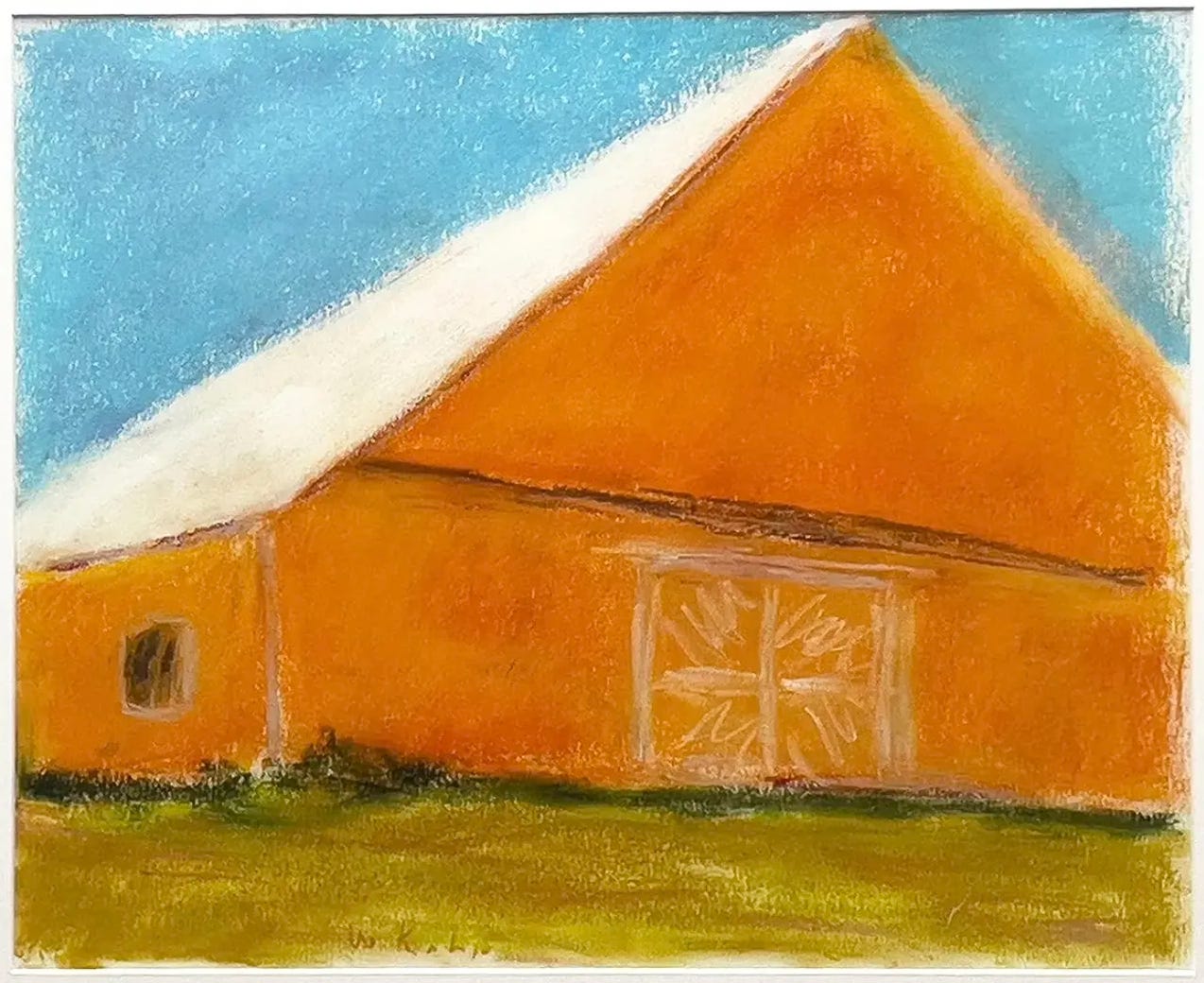
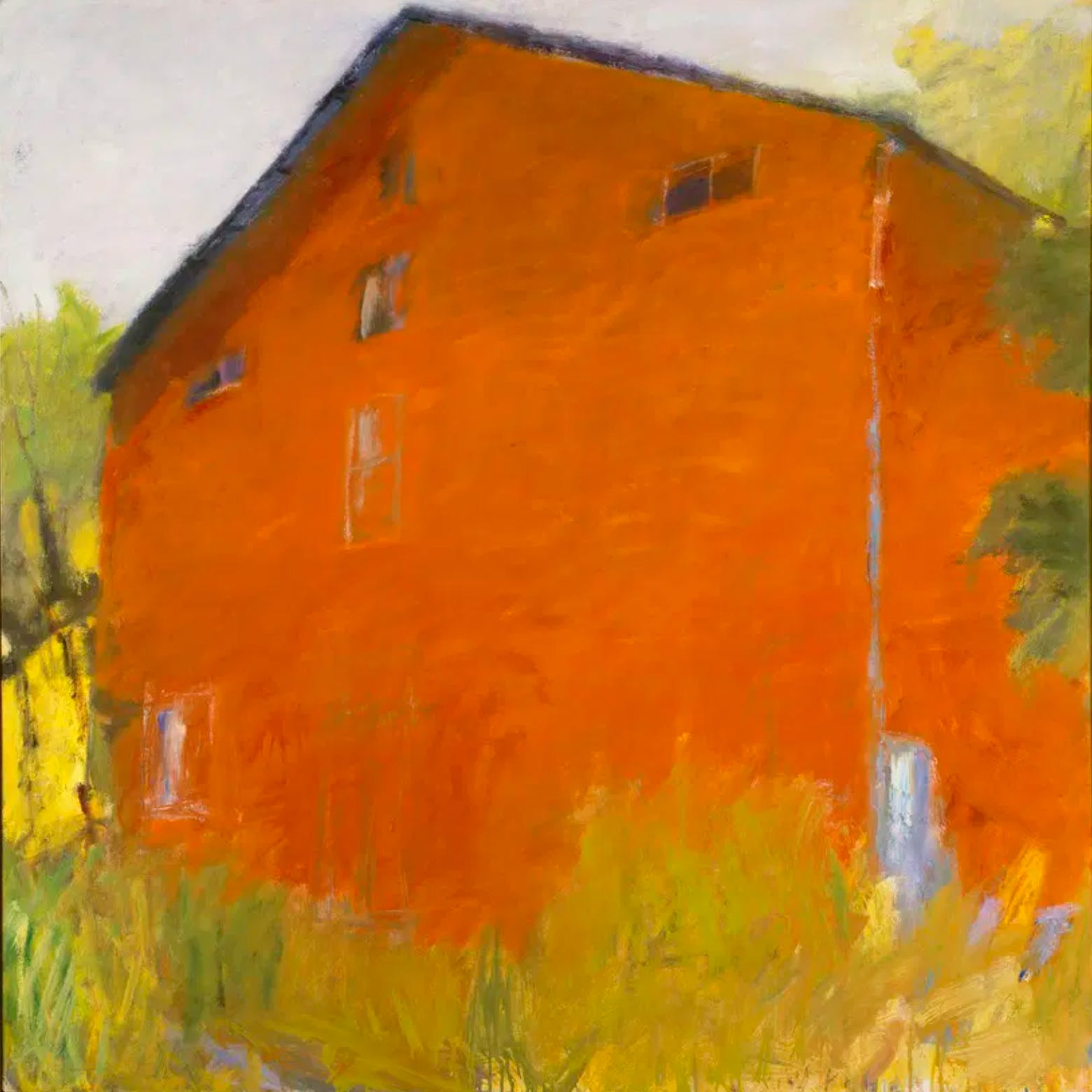
The purple barn and orange barn, for example, demonstrate two very different emotional possibilities within essentially the same subject. In Purple Barn, Circa 2003 (Fig.3), the structure rises out of a luminous yellow-green landscape beneath a cool blue sky. The barn appears almost monumental despite the intimate scale of the pastel. Its purple surface is not an attempt to reproduce natural color; instead, it creates a chromatic counterpoint to the yellow field and blue sky surrounding it. Orange Barn, Circa 2003 (Fig. 4) operates differently. Here, Kahn brings the structure much closer to the viewer, allowing the barn itself to dominate the composition. The warm orange becomes almost a field of color, interrupted only by the roofline, doorway, and small architectural details. The result approaches abstraction while remaining firmly rooted in the observed world.
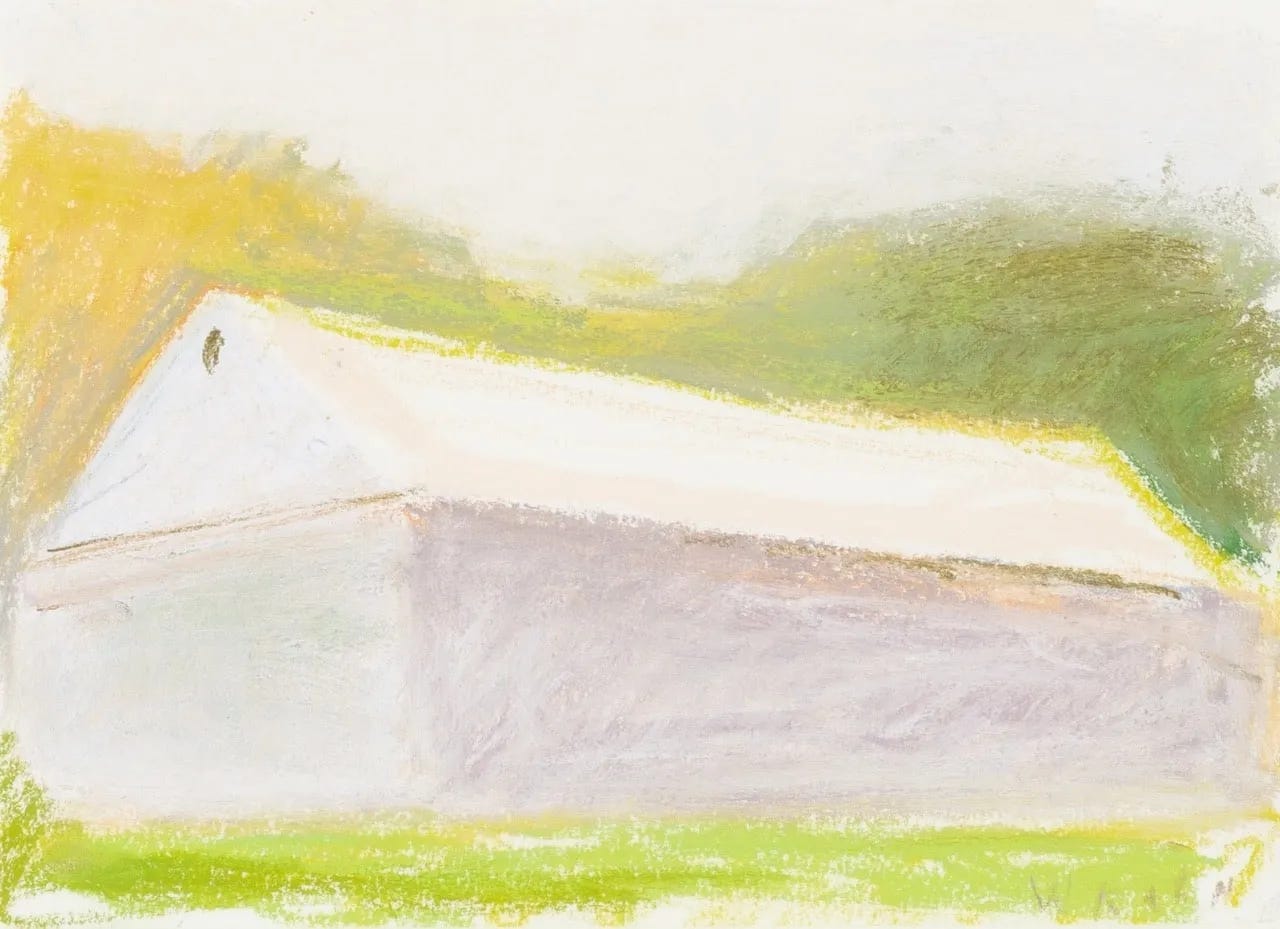
A third work, Long Barn, 2002 (Fig. 5), is particularly interesting in this context. Measuring only 7 × 10 inches, it demonstrates how much Kahn could accomplish with an intimate format. Rather than relying on a monumental scale, Kahn uses economy; a few architectural shapes, a compressed landscape, and a carefully calibrated relationship between color and light. The small size encourages the viewer to look closely at the surface and focus on the expressive potential of pastel.
Pastel was particularly suited to Kahn’s approach because, unlike the slower, more layered process of oil painting, pastel allowed him to work directly and physically with color. The strokes remain visible, giving the surface a lively energy. In these works, the viewer can see the gesture of the hand in the grass, field, sky, and barns.
Ultimately, Kahn’s barns are revered because they offer something more complex than nostalgia. They are not sentimental pictures of an idealized rural America. They are investigations into how we see. A barn gives Kahn a solid geometric form. The surrounding landscape gives him composition, movement, and light. Color allows him to alter the emotional temperature of the scene. Pastel preserves the immediacy of his hand. The result is a landscape that can be understood in two ways simultaneously, as a recognizable place and as an abstract arrangement of color and form. In Kahn’s hands, the barn becomes almost a laboratory for painting itself, where color, form, and the act of seeing emerge as the true subjects of his work.
Wolf Kahn has been the subject of numerous solo exhibitions and museum presentations throughout his career. His work has been exhibited at institutions including the Whitney Museum of American Art, New York; the Museum of Modern Art, New York; the Metropolitan Museum of Art, New York; the Museum of Fine Arts, Boston; the Hirshhorn Museum and Sculpture Garden, Washington, D.C.; and the Los Angeles County Museum of Art. Notable exhibitions include A Dialogue Between Traditional & Abstract Art: Paintings, Pastels, & Monoprints 1970–1995, which opened at the Boca Raton Museum of Art in 1996 and traveled to several American museums; Wolf Kahn: Fifty Years of Pastels (2000), which toured a number of institutions; Wolf Kahn’s Barns at the Gibbes Museum of Art, Charleston (2006); Wolf Kahn: Landscapes of Light, 1953–2006 at the Brattleboro Museum & Art Center (2006); and Wolf Kahn: Barns at the Blowing Rock Art & History Museum, North Carolina (2014). His honors include a Fulbright Scholarship, a John Simon Guggenheim Fellowship, the National Academy of Design’s Lifetime Achievement Award, and the U.S. Department of State’s International Medal of Arts (2017). In 2019, Kahn received an honorary Doctor of Arts degree from Marlboro College in Vermont. His work is represented in major public and private collections.
For more information inquire below:
Thanks for reading! Subscribe here to receive Artxiom in your inbox each week: