

Weekly writing about the art market and the convergence of art and technology. By day, I’m a partner at the Robert Fontaine Gallery and a data science consultant. By night, I write Artxiom, ideas at the intersection of art, technology, and finance.
If you haven’t subscribed, join today by subscribing here:
Exceptional Works: Yayoi Kusama
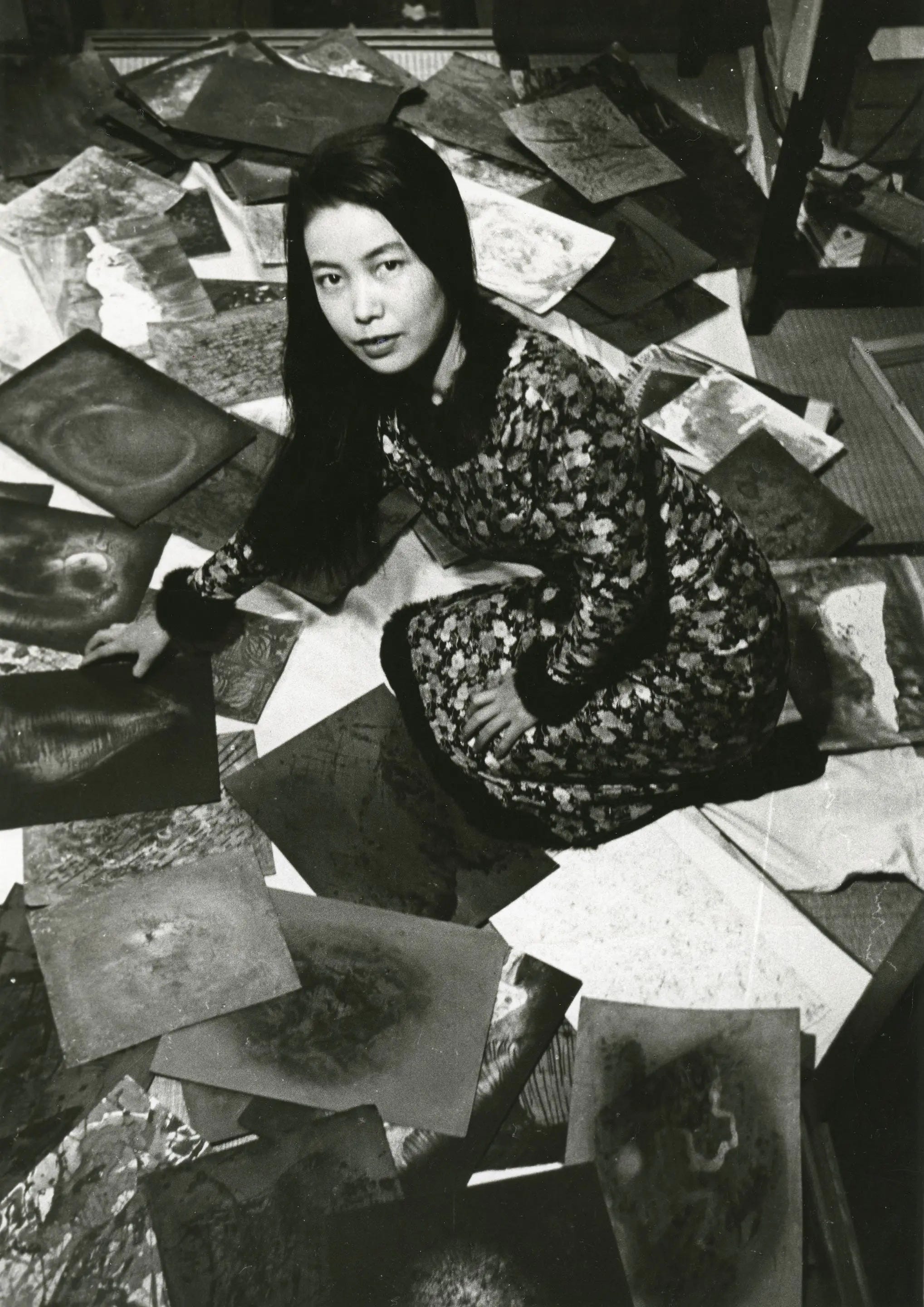
“My art originates from hallucinations only I can see. I translate the hallucinations and obsessional images that plague me into sculptures and paintings.”
- Yayoi Kusama
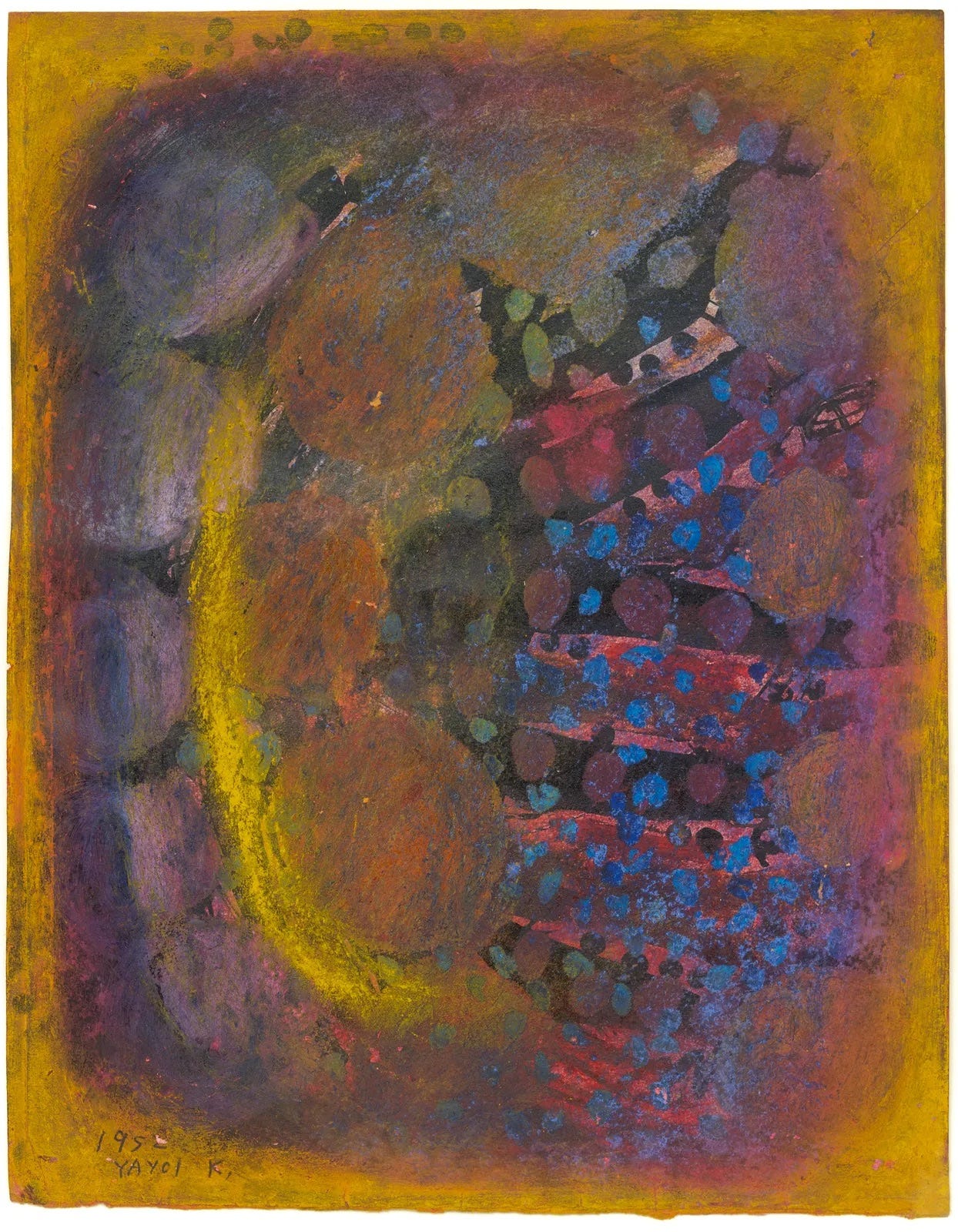
Yayoi Kusama
A Flower, 1952
Gouache and pastel on Paper
11 x 8 1/4 inches
Signed and dated '1952 YAYOI K' (lower left); signed again, titled, inscribed and dated again 'Japan Yayoi Kusama 1952 A Flower' (on the reverse)
Provenance:
-Peter Blum Gallery, New York
-Private Collection
-Christie's, New York, Post-War 2006
-Private Collection, NY
A Flower (1952) belongs to a brief, formative moment in Yayoi Kusama’s career, one that is often overshadowed by her later series, especially her Infinity Nets, yet this early body of work has become essential to understand how her artistic language took shape.
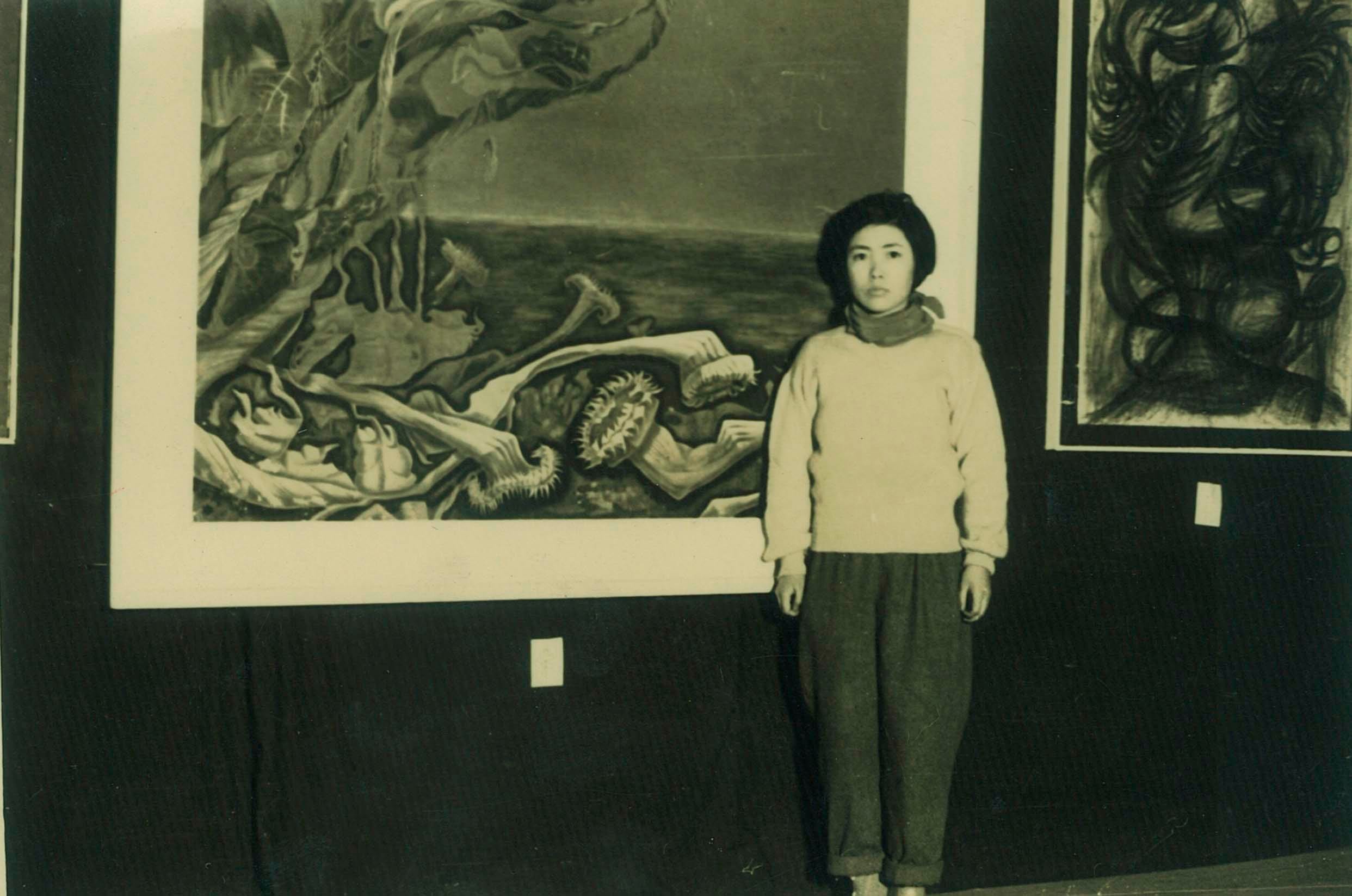
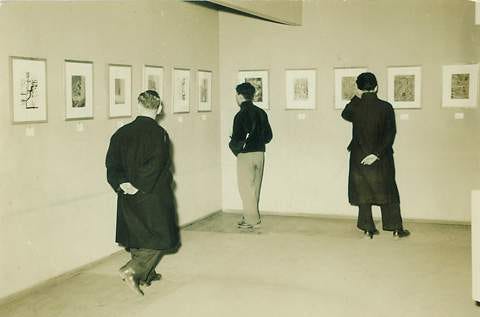
Born in 1929 in Matsumoto, Japan, Kusama grew up in a very conservative household where her early desire to become an artist was not encouraged. From childhood, she experienced vivid hallucinations: fields of dots, engulfing patterns, and proliferating forms that would later become the foundation of her work. She studied traditional Japanese painting, but quickly rejected its constraints, gravitating instead toward a more experimental, psychologically driven form of expression. By early 1950s, she was producing works on paper that explored organic forms, abstraction, and repetition. These works culminated in her first solo exhibition in 1952 (Fig. 3), the same year A Flower was created and possibly part of the show.
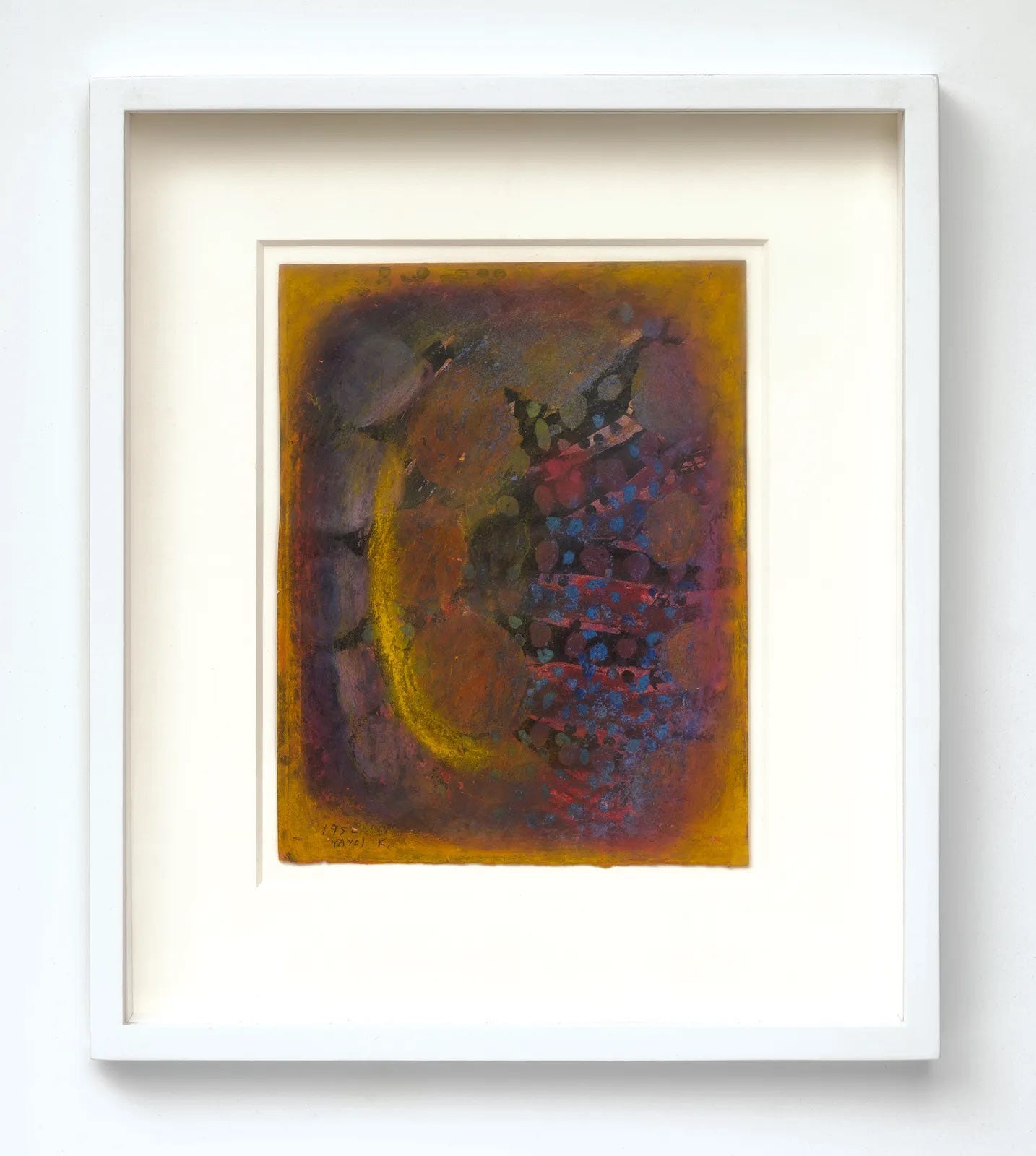
A Flower (Fig. 4) emerges from this early period, before Kusama left Japan for the United States in 1957. Although the title suggests a natural subject, the painting resists straightforward representation. Instead of a botanical image, Kusama presents a dense, pulsating field of color and texture. Biomorphic shapes hover between recognition and dissolution, while clustered, cell-like formations begin to accumulate across the surface. A glowing, almost radiant arc of yellow cuts through darker tones, suggesting not light in a conventional sense but an internal energy or aura. The composition feels less like an observed object and more like an internal vision, an attempt to render perception itself.
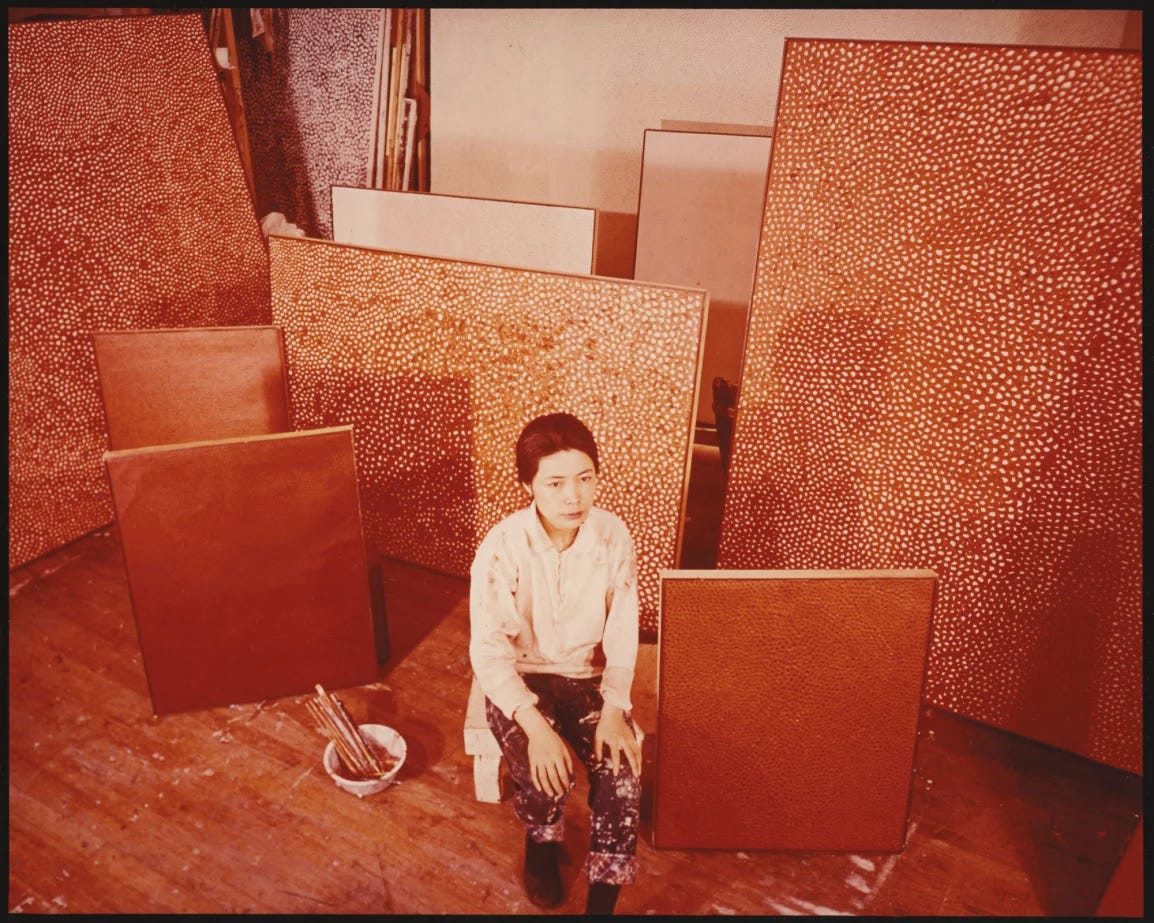
This tension between figuration and abstraction is key in Kusama’s body of work. In A Flower, Kusama has not yet fully systematized the obsessive repetition that would define her later work, but its seeds are unmistakable. The clustered marks anticipate the allover patterning of her later series, particularly her Infinity Net paintings(Fig. 5), which she began shortly after moving to New York. In those works, looping arcs repeat endlessly across large canvases, creating immersive fields that evoke infinity and self-obliteration. Compared to the disciplined, almost meditative surfaces of the Infinity Nets, A Flower feels exploratory; its forms still shifting, its structure still unstable. It captures Kusama at the moment when her inner visions are beginning to organize into a coherent visual system.
The body of work surrounding A Flower, produced roughly between 1950 and 1955, forms what it is called her “proto-Infinity” phase. These pieces are typically modest in scale and executed on paper (Fig. 1,6), yet they carry significant historical weight. Many were destroyed by Kusama before her departure from Japan, making surviving examples exceptionally rare. They show her moving away from representation toward a language rooted in accumulation, repetition, and the dissolution of boundaries, concepts that would later define her entire career.
From a market perspective, this early period occupies a distinct and somewhat paradoxical position. Kusama today is one of the most recognizable and commercially successful contemporary artists in the world, with a market that spans everything from prints to museum-scale installations. At the top end, her Infinity Nets command prices in the multi-million dollar range. They are visually iconic, immediately identifiable, and deeply embedded in the narrative of postwar art in New York. Works like A Flower, however, operate differently within the market. They lack the instantly recognizable visual signature that defines Kusama’s mature style, yet they possess something arguably more important to certain collectors, proximity to origin. Their rarity, exacerbated by the destruction of many early works, creates a significant supply constraint. As a result, these paintings tend to attract a more specialized audience, including museums and collectors focused on building historically grounded collections. While generally valued below the largest and most famous Infinity Net paintings, strong examples from this early period can still achieve prices in the high six to low seven-figure range, depending on provenance, condition, and exhibition history. In general, these early works are quieter, more intimate, and less immediately legible, but they carry a different kind of weight; they reveal how Kusama became Kusama.
In recent years, there has been a subtle but meaningful shift in how these early works are perceived. As scholarship deepens and institutions place greater emphasis on origin points within an artist’s career, pieces like A Flower are being re-evaluated not as peripheral experiments but as foundational statements. They show the emergence of repetition, accumulation, and psychological space that would later transform contemporary art.
In conclusion, A Flower is less a depiction of a natural object than a record of a mind in transition. It captures Kusama at a threshold, still grounded in the physical world, yet already dissolving it into pattern and infinity.
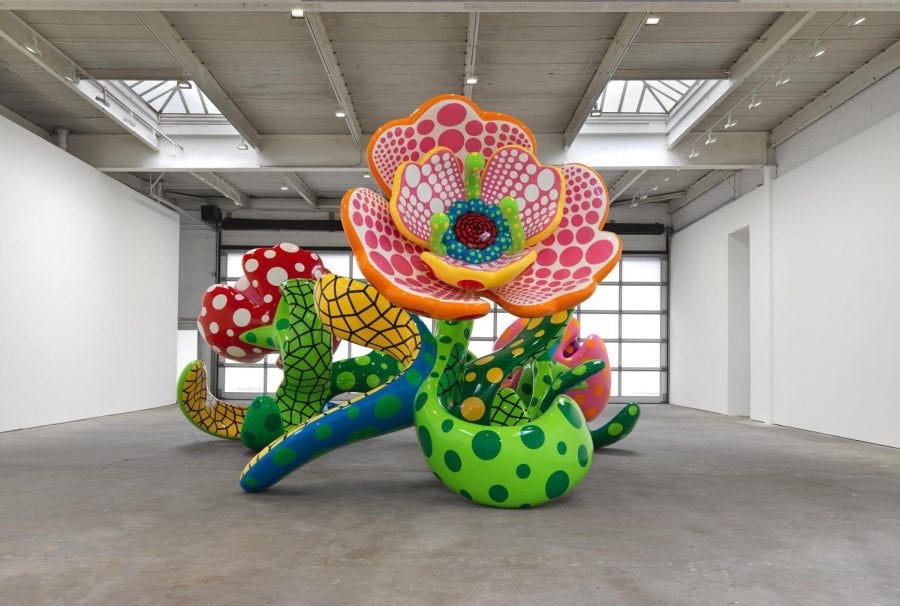
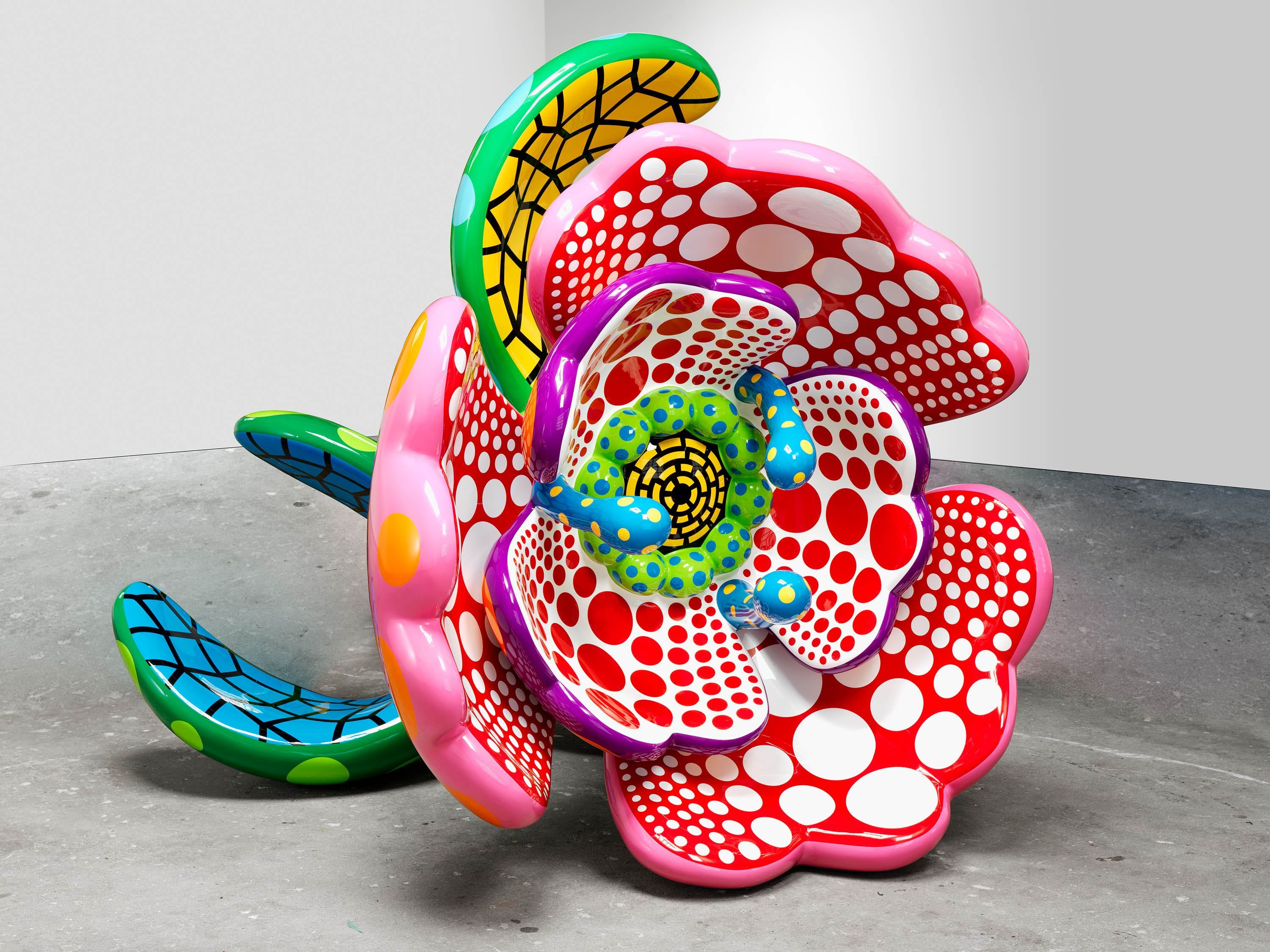
Yayoi Kusama has been the subject of numerous solo exhibitions and presentations. She represented Japan at the Venice Biennale in 1993. She has been the subject of international touring exhibitions organized by institutions such as the Los Angeles County Museum of Art and the Museum of Modern Art, New York (1998); Le Consortium, Dijon, France (2000); National Museum of Modern Art, Tokyo (2004); and Museum Boijmans Van Beuningen, Rotterdam (2008); as well as a major retrospective shown at the Museo Nacional Centro de Arte Reina Sofía, Madrid; Centre Georges Pompidou, Paris; Tate Modern, London; and Whitney Museum of American Art, New York (2011–12). The artist has won numerous awards and honors, including the Asahi Prize (2001), French Ordre des Arts et des Lettres (2003), and 18th Praemium Imperiale award for painting (2006). Kusama has been the subject of documentary films, Near Equal Yayoi Kusama: I Adore Myself (2008), and Kusama: Infinity (2018).
For more information inquiore below:
Thanks for reading! Subscribe here to receive Artxiom in your inbox each week: